Membrane Thickness and Warranty Path
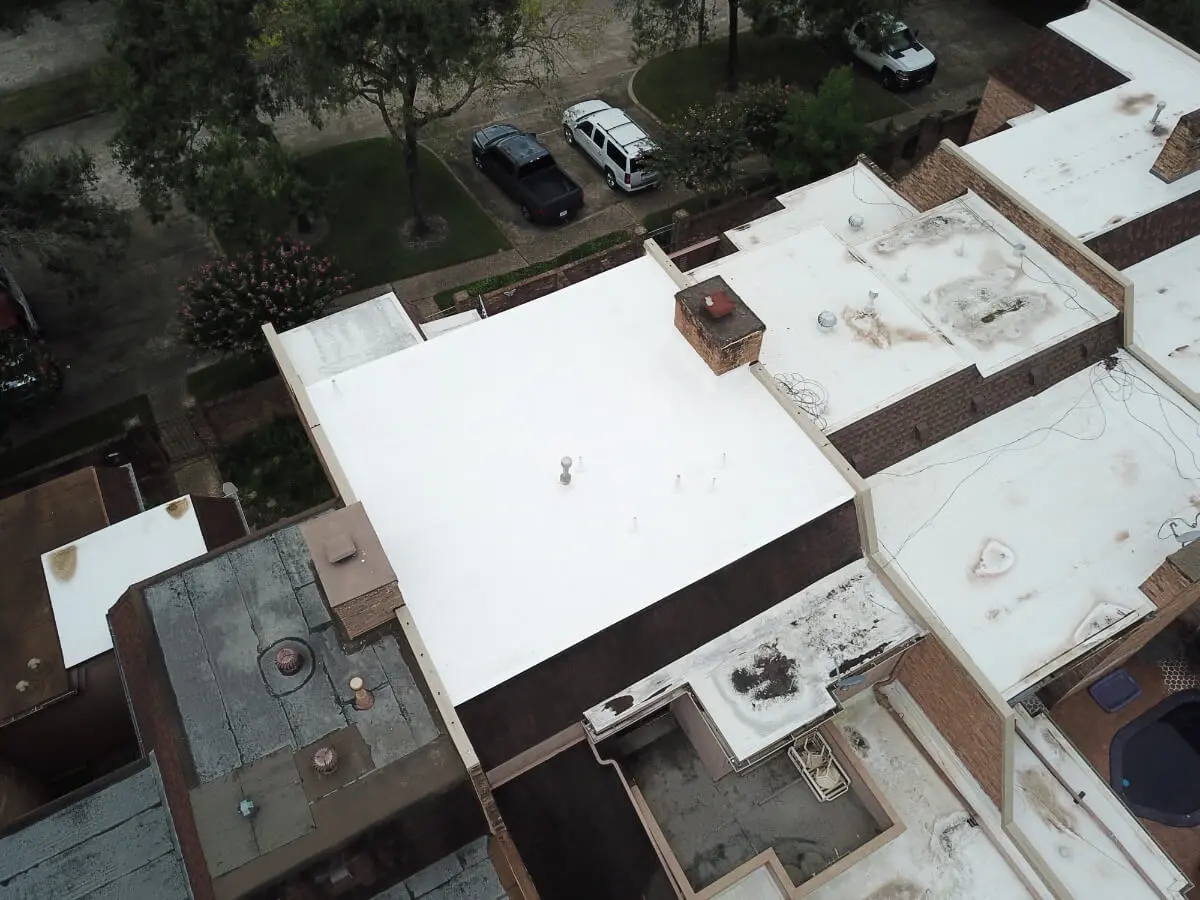
60-mil TPO is the standard specification for most St Louis commercial buildings with normal rooftop equipment and standard maintenance traffic. Every major manufacturer offers a 20-year NDL warranty on 60-mil installed to their specifications. Installed cost runs in the range of $7 to $12 per square foot depending on project scale, insulation requirement, and existing roof conditions. For the typical single-story warehouse, office building, or strip retail property in the metro, 60-mil is the cost-effective path to a full warranty life.
80-mil TPO costs roughly 15 to 20 percent more per square but extends manufacturer warranty life to 25 years on most product lines and provides a longer capital-planning horizon for owners who want to defer the next reroofing decision past the 20-year mark. The additional thickness handles higher puncture loads from rooftop mechanical traffic and provides a thicker weathering layer above the scrim. We specify 80-mil on high-traffic rooftops, on buildings with demanding maintenance schedules such as data centers serviced quarterly, and for owners who have run the lifecycle math and found the 25-year term favorable against their hold horizon.
Attachment Methods for St Louis Buildings
Mechanically attached TPO is the dominant method in St Louis for good reason: it installs quickly, does not require substrate priming, and carries competitive pricing on large commercial projects. The fastener pattern is designed to the IBC wind-uplift table for each project. Field zones, perimeter zones, and corner zones each carry different fastener spacing. On large flat commercial roofs in the St Louis derecho corridor, corner-zone fastener density is the specification item that separates adequate installations from those that produce insurance claims after the next June severe-weather event.
Fully adhered TPO is specified when wind-uplift requirements exceed what mechanical attachment can deliver, when the deck cannot accept additional penetrations, or when the project requires the cleanest membrane profile with no fastener telegraphing. Adhesive application requires temperature control. We do not apply TPO bonding adhesive below 40 degrees Fahrenheit substrate temperature, which affects scheduling on early-spring and late-fall projects across the metro.
Induction-welded TPO is the right method for metal decks where screw penetrations are undesirable. Induction-weld plates are attached to the deck surface, the membrane is laid loose over the insulation, and an induction-welding tool spot-welds the membrane to the plates through the membrane in a single pass. This configuration is common on Hazelwood and Earth City industrial facilities with exposed steel deck where the building owner wants to avoid additional penetrations through aging deck material.
Seam Integrity in the St Louis Freeze-Thaw Zone
TPO seams are hot-air welded. The weld quality depends on welder temperature, travel speed, roller pressure, and membrane surface condition. Cold welds produced when the welder temperature is too low or travel speed too fast look intact on the day of installation but separate after the first hard freeze in November or December. Contaminated welds, where membrane surface moisture or chalk from aging membrane is not adequately cleaned before welding, fail the same way and show up as leaks on the first significant rain after freeze-up.
Our seam protocol requires factory-trained and actively certified weld operators. Trial welds are performed at the start of each production day and at ambient temperature changes greater than 15 degrees Fahrenheit. Every seam weld is tested with a 5-pound weighted roller immediately after welding. Every linear foot of seam is probe-tested with a rounded probe tool before the roof is closed out. Failed sections are cut out and re-welded, not spot-repaired with lap sealant. Closeout documentation includes seam test photos keyed to a roof zone diagram so the building owner has a verifiable record.
Common Failure Modes We Prevent
Parapet flashing separation is the most frequent failure we document on St Louis TPO roofs three to eight years old. The parapet flashing strip is heat-welded to the field membrane and counter-flashed at the wall. When the counter-flashing detail is inadequate or building movement opens a gap between the counter-flashing and the wall, water infiltrates and runs behind the flashing strip. We install parapet flashings to manufacturer-published detail specifications and photo-document every parapet detail against the spec sheet before closeout.
Drain collar failure is the second most frequent failure mode. TPO drain collars are clamped or welded depending on the drain type, and the clamping ring is the weak point. If the ring is not fully torqued, or if it is not compatible with the drain body material, the collar separates. We verify drain compatibility before ordering materials and torque every clamping ring to the manufacturer's specification. Drains are the last item we inspect before issuing closeout documentation.
Walkway pad omission is a straightforward cause of premature membrane failure on buildings with regular rooftop service. HVAC technicians servicing rooftop units on a quarterly schedule will destroy unprotected TPO in two seasons on a St Louis industrial building. Every access path from roof hatch to rooftop equipment gets walkway pads in our standard scope, sized to the expected traffic frequency and equipment type.
Missouri IBC Requirements and Insulation Stack
Missouri's adoption of the International Building Code and the International Energy Conservation Code sets minimum insulation requirements for low-slope commercial roofs. The current energy code path for most St Louis commercial buildings requires insulation to meet a continuous R-value threshold that the assembly specification must document and verify at closeout. Tapered polyiso is the standard primary insulation for St Louis TPO systems because it achieves the required R-value while directing water to drains and eliminating the chronic ponding zones that shorten membrane life.
A high-density cover board over the polyiso primary insulation is standard practice on St Louis TPO projects for two reasons. First, it protects the polyiso from thermal bridging at the mechanical fasteners in the system above. Second, it provides hail-impact resistance. St Louis hail events from April through October can produce hailstones in the 1-inch to 1.5-inch range that puncture standard-density TPO laid over standard-density polyiso without a cover board. The HD polyiso or gypsum-based cover board distributes impact energy across a wider area and is the specification element that separates a hail-resistant assembly from a standard one.
TPO Recover vs Full Replacement
Before we quote a tear-off on any St Louis commercial building, we determine whether the building is a recover candidate. We pull moisture cores at five to ten representative locations and run a visual seam and flashing inspection. If the existing insulation is dry, the deck is sound, and the current membrane has not weathered past the point of providing a clean substrate, the building is often a recover candidate. A TPO recover over a prepared existing roof saves the owner the tear-off labor, the disposal cost, and days of a building exposed to weather.
Recover is not always on the table, and we will say so directly. Code limits a building to two roof membranes, so if the building already carries two, the next move is a tear-off regardless of the membrane's apparent condition. Wet insulation, a compromised deck, or widespread saturation also takes recover off the menu. Covering trapped moisture relocates the problem and voids the warranty at the next manufacturer inspection. We give you the core results and the recommendation in writing so the recover-versus-replace decision is yours to make on real data rather than a contractor's preference.