BUR Assessment Protocol for St Louis Buildings
Gravel-surfaced BUR conceals surface condition, so we begin every BUR assessment by moving aggregate aside in representative locations and visually inspecting the felt surface below. Blistering, surface cracking, and open splits in the felt surface indicate which zones are actively deteriorating versus which are stable. Flood-coat alligatoring, the surface oxidation pattern that resembles alligator skin, indicates an aged surface but does not necessarily indicate a failing system. It is a qualitative input, not a decision point by itself.
Moisture-core sampling is the decision input. We pull cores in five to ten locations on roofs up to 20,000 square feet, scaled to roof area on larger buildings. Core locations are chosen at the zones most likely to show saturation: within two feet of perimeter drains, at low points in the slope pattern, and at any location where ponding has been observed or where the aggregate has been disturbed. Wet cores in more than 25 percent of the sampled area make the case for tear-off. Below 25 percent, targeted insulation replacement with a recover cap is often the defensible capital path.
Deck inspection ports are drilled under wet cores and at deflection points. Pre-war St Louis commercial buildings frequently have concrete, gypsum-board, or wood-fiber plank decks that deteriorate differently than metal deck. Saturated gypsum decks lose structural integrity in ways that are not visible from above and are not detected by moisture cores alone. Visual deck inspection under the BUR insulation is the only way to assess deck condition in these buildings, and it is a step we do not skip on any BUR assessment.
BUR Repair vs Recover vs Replace
Repair is appropriate when the BUR system is structurally sound, insulation is dry, and failure is localized to specific flashing details or isolated felt splits amenable to spot repair. For many older Downtown and Midtown commercial buildings that have been maintained on a reactive basis, a documented repair scope that addresses the identified failure points and seals the aggregate surface with an appropriate coating can extend the asset by five to ten years while the owner plans the capital cycle for full replacement.
Recover is appropriate when the membrane is aged but insulation is largely dry and deck is sound. A modified bitumen cap sheet or a single-ply membrane installed over a prepared BUR surface adds a new waterproofing layer without the cost and disruption of tear-off. The recover path saves 30 to 50 percent of total replacement cost on buildings where the substrate condition supports it. We present this option explicitly when our inspection supports it. A repair or recover recommendation on a BUR inspection is common in the St Louis market, not exceptional.
Replace is the right scope when insulation is wet in more than 25 percent of the sampled area, when deck condition is compromised, or when the repair history makes the continued liability of a maintain-and-repair strategy unacceptable to the owner. Full tear-off and replacement with a warranted system, TPO, EPDM, or modified bitumen, resets the asset's condition baseline and produces a closeout package with manufacturer warranty documentation that the next owner or lender can rely on.
BUR Tear-Off on Pre-War St Louis Buildings
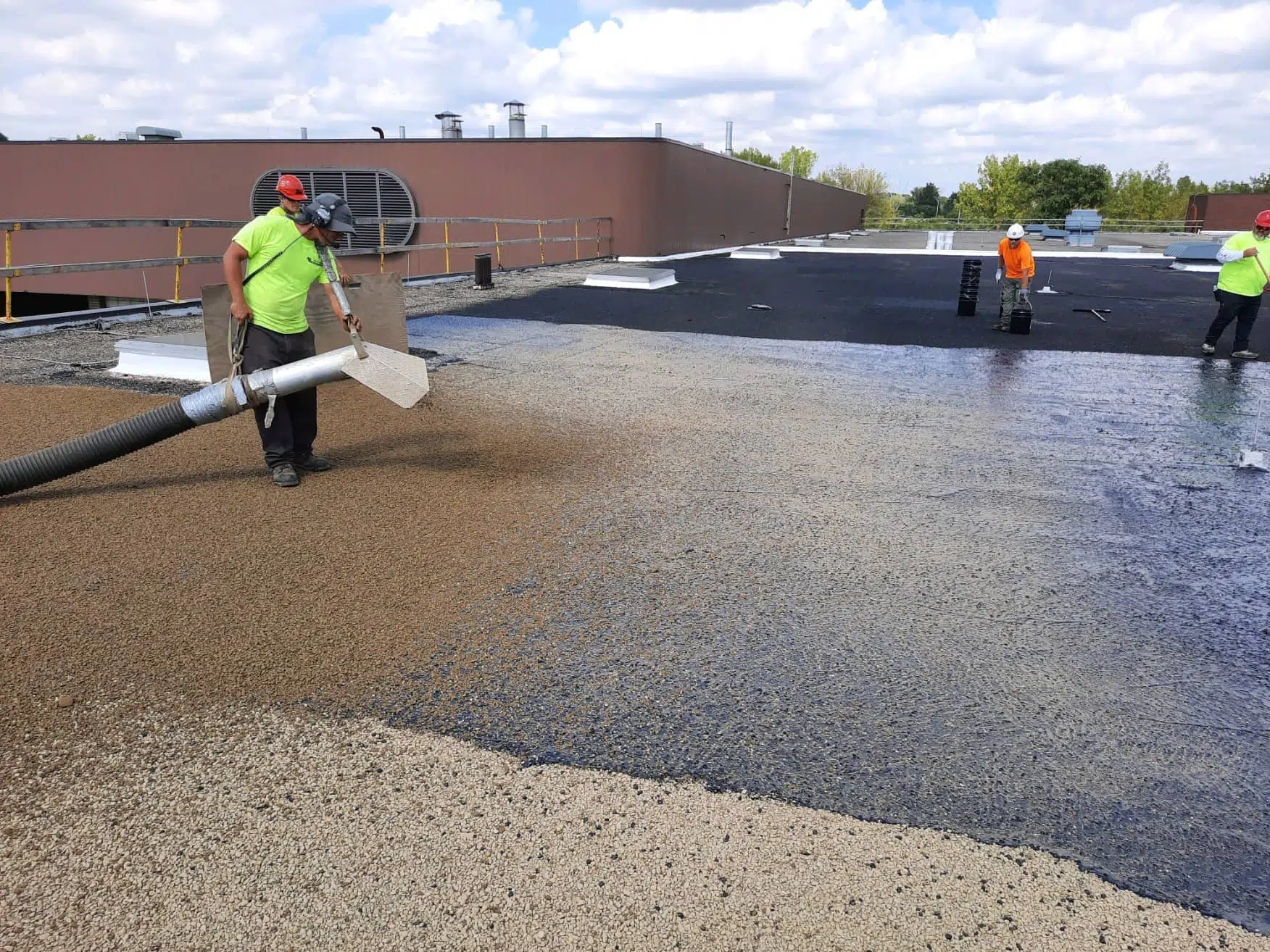
Tear-off on pre-war masonry commercial buildings in Downtown and Midtown requires logistics planning that does not apply to a suburban warehouse job. Aggregate removal requires vacuum equipment. Blowing gravel off a Downtown rooftop onto the street below is not an option for safety, liability, or code compliance reasons. Felt and insulation debris is staged to containers that exit the building through coordinated freight elevator or crane scheduling.
Pre-war buildings often have significant parapet heights, limited roof access, and mechanical penthouse structures that create staging constraints on every project. We assess access and staging in the pre-bid walk and include the logistics plan in the proposal. Owners in the Downtown and Midtown market who have dealt with contractors that did not plan these details know exactly what that lack of planning costs them during the project, and they expect us to have the plan in hand before the contract is signed.
BUR on the South City Industrial Corridor
The south city industrial corridor from the Anheuser-Busch campus in Soulard south through Benton Park and Carondelet holds a significant population of pre-1980 commercial and industrial buildings on original BUR systems. Many of these buildings have never had a professional condition assessment. The repair history is layered: original 1960s or 1970s gravel-surfaced BUR with emulsion patches over the worst leak areas, sometimes a modified bitumen cap sheet over a section of the original felt, and original cast-iron drain bodies with clamping rings that corroded through decades ago.
The south city industrial corridor is also where we find the most significant deck corrosion on BUR assessments. Metal deck on river-adjacent buildings, particularly on the industrial properties closest to the Mississippi River floodplain, has experienced cyclical moisture exposure from both above and below over decades. Deck inspection ports at wet-core locations on these buildings frequently reveal through-corrosion that changes the scope from a recover to a structural repair before any new membrane can be installed.
Institutional BUR on Washington University Adjacent Buildings
The Washington University in St Louis campus and the surrounding academic and institutional buildings in Clayton and University City include a number of pre-1970 structures that carry original BUR on complex roof profiles. Gothic stone buildings with slate-covered pitched sections and flat BUR sections at lower levels present a mixed-system condition assessment challenge: the flat BUR is on its own service timeline, separate from the slate, and requires its own moisture-core assessment and condition rating.
Institutional owners like WashU manage their roofing through capital planning cycles that require multi-building condition data formatted for a facilities committee review. We produce condition reports for institutional campus buildings that include consistent condition ratings, remaining useful life estimates, and capital cost bands for repair, recover, and replacement, the format that a facilities director preparing a multi-year capital budget actually needs to justify the request.
Drainage Improvements as Part of BUR Scope
The most common technical deficiency we identify during BUR assessments on older St Louis commercial buildings is inadequate drainage. Interior drain layouts designed to 1960s or 1970s minimum code standards are frequently insufficient to handle St Louis's high-rainfall events, particularly the late-spring events that can deliver three to four inches in 24 to 48 hours. Ponding zones that developed as the roof deck settled over 40 years create chronic standing water that accelerates BUR deterioration faster than any other single factor.
Drainage improvements, tapered insulation to eliminate ponding zones, additional interior drains, and extended drain leaders to prevent blockage from debris are part of the scope we develop alongside the membrane recommendation. A BUR replacement that does not address the drainage deficiency that drove the original BUR failure will produce the same failure pattern on the new system within five to ten years. We include drainage analysis in every BUR scope as a required scope element, not an optional upgrade.