SBS vs APP Modified Bitumen for Missouri Climate
SBS modified bitumen uses a rubber polymer modifier that gives the membrane rubber-like flexibility. It stretches and recovers rather than cracking under thermal movement. SBS is the correct choice for St Louis buildings exposed to significant freeze-thaw cycling. The membrane accommodates deck movement through the 18 to 22 freeze-thaw events per average St Louis winter without fatiguing at laps and flashings. SBS torch-applied base sheet and cap sheet is the standard specification for most St Louis commercial modified bitumen work.
APP modified bitumen uses a plastic polymer modifier that produces a stiffer membrane with higher heat resistance. APP is better suited for very high surface-temperature environments in warmer climates. APP is not the standard St Louis specification because its lower flexibility at cold temperatures makes it more vulnerable to cracking in hard freeze events. We specify APP only when the building's use and exposure profile specifically favors it over SBS, and we document that reasoning in the project specification.
Torch-Applied Systems on Concrete-Deck Buildings
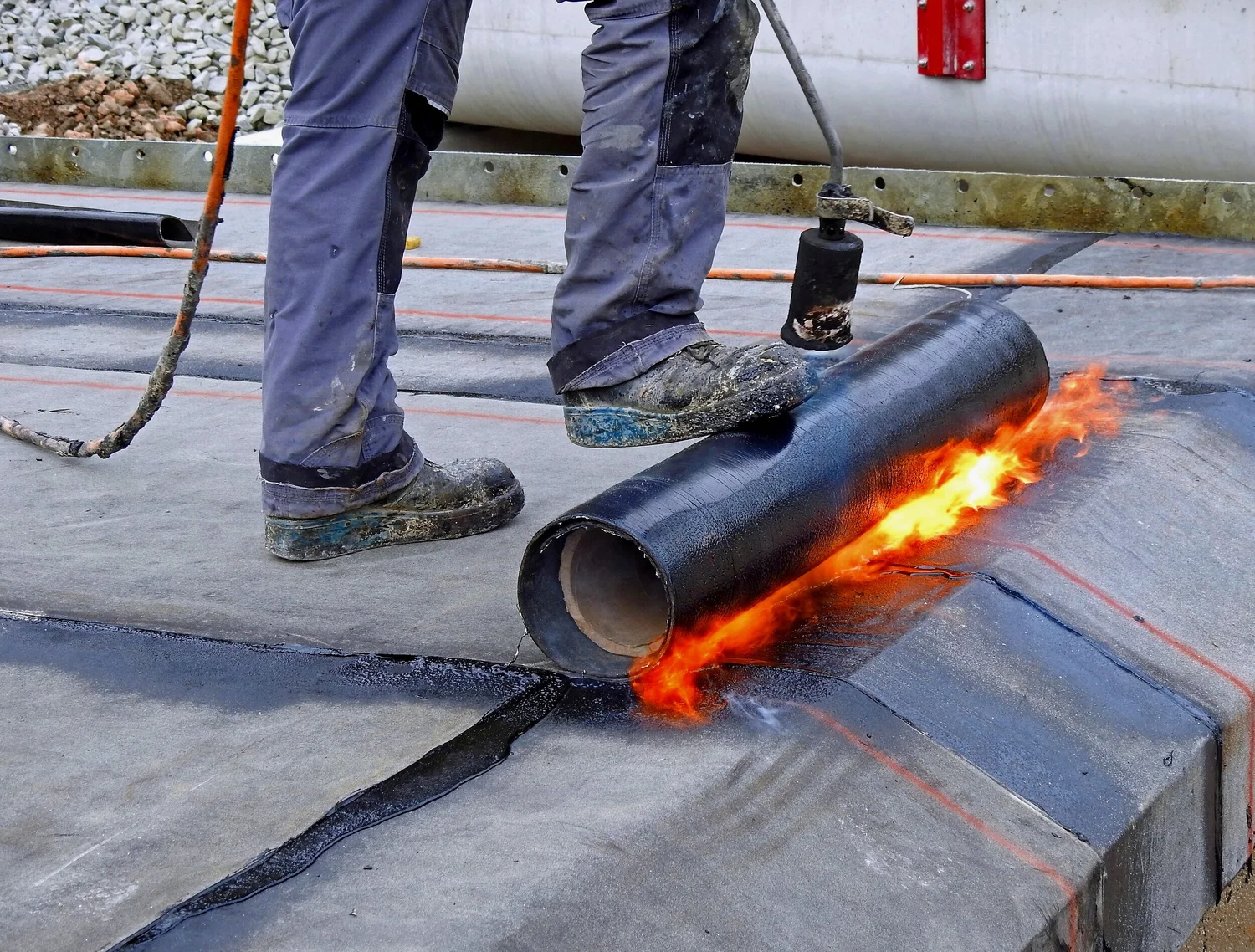
Torch-applied modified bitumen is the dominant method for mod-bit work in St Louis because it produces the most reliable seam and lap adhesion. The open-flame torch heats the underside of the membrane until the asphalt reaches the correct temperature and bonds to the substrate. Proper torch technique requires trained operators. Undertorching produces weak laps that separate in freeze-thaw. Overtorching burns through the membrane field and creates warranty problems that show up at the manufacturer's closeout inspection.
Pre-war and mid-century masonry commercial buildings in Midtown, Downtown, and the warehouse districts frequently have concrete or poured gypsum decks that are not suitable for mechanical fastening of single-ply membrane. Fully adhered modified bitumen is often the appropriate specification for these buildings. It does not require deck penetration, distributes load across the full deck surface, and can be applied over prepared concrete substrates with appropriate primers.
In the Midtown arts corridor on Grand Boulevard, where converted industrial and institutional buildings are common, we frequently encounter complex roof geometries with multiple parapets, skylights, and mechanical penetrations that require field-fabricated flashings. Modified bitumen lends itself to complex flashing geometries because the membrane can be cut, formed, and torch-welded on-site to any configuration that field conditions require.
Cold-Applied Modified Bitumen for Occupied Buildings
Cold-applied SBS modified bitumen uses a solvent or water-based adhesive instead of an open flame, which makes it appropriate for occupied buildings where open-flame application is not permitted or where the building's fire-prevention protocol prohibits hot work. Many Downtown St Louis office towers, Clayton CBD high-rises, and active medical campus buildings are in this category. The fire watch requirement on an occupied high-rise is operationally difficult to manage in ways that cold-applied systems eliminate.
Cold-applied systems require careful surface preparation. Adhesive bond strength depends on a clean, primed substrate, and cure time is longer than torch-applied. The performance result is equivalent when installation protocols are followed, but installation pace is slower and temperature requirements are stricter. We specify cold-applied modified bitumen for any project where the fire-watch or no-hot-work requirement applies, and we build the additional cure time into the project schedule so it is not a surprise during production.
Modified Bitumen as a Recover over Existing BUR
A significant number of pre-1980 St Louis commercial buildings carry original built-up roofing. Where BUR insulation is dry, confirmed by moisture-core sampling, modified bitumen recover is a cost-effective path that extends the asset by 15 to 20 years without a full tear-off. The existing gravel surface is swept and the BUR membrane is assessed for adhesion and surface condition. A modified bitumen cap sheet, typically a granulated SBS cap, is torch-applied or cold-applied over a prepared base.
The recover path requires careful attention to the existing drainage system. BUR-era drains frequently have deteriorated cast-iron or lead collars that are not compatible with modern modified bitumen flashings. We assess every drain during inspection and specify collar replacement where the existing drain cannot be properly flashed to the new system. Leaving an incompatible drain collar in place under a new modified bitumen system is the leak that appears in year two and is expensive to remediate after the recover layer is installed.
Granule Loss and Surface Aging on Missouri Commercial Buildings
Modified bitumen cap sheet granule loss is the primary aging indicator we assess during inspections on St Louis commercial buildings. Cap-sheet granules protect the asphalt matrix from UV oxidation. When granules erode, the asphalt is exposed directly to Missouri's summer UV load and high surface temperatures, which accelerate the oxidation and brittleness that eventually leads to cracking and lap separation. Significant granule loss in a concentrated zone, often south-facing and around drain basins, indicates that section of the roof is approaching the end of its effective service life.
We document granule coverage during every modified bitumen inspection and include it in the condition report as a remaining-service-life indicator. A roof with 70 percent granule coverage on a 15-year-old two-ply system is in a materially different position than a same-age system with 40 percent coverage on the south slope. That distinction drives whether the owner is looking at a 5-year replace cycle or a 10-year one, and it is the kind of information that makes capital planning defensible to a finance committee.
Modified Bitumen System Costs and Long-Term Value
Modified bitumen systems typically cost 15 to 25 percent more per square than single-ply mechanically attached TPO at equivalent insulation thickness, because the multi-ply application requires more labor. The cost premium is justified on buildings where the multi-layer redundancy is a design requirement: buildings with high interior humidity that demands greater vapor control, occupied masonry buildings where deck penetrations are not acceptable, and historic structures where the specification must accommodate irregular substrate conditions.
A properly specified two-ply SBS system on a St Louis commercial building with documented annual maintenance delivers 20 to 25 years of service life. The combination of the base sheet and the granulated cap sheet provides a redundant waterproofing system that can sustain a cap sheet failure in a localized area without immediately admitting water to the building. That redundancy is the fundamental value proposition of modified bitumen over single-ply, and it is the reason medical campuses, older masonry institutional buildings, and high-value industrial facilities in St Louis continue to specify it.