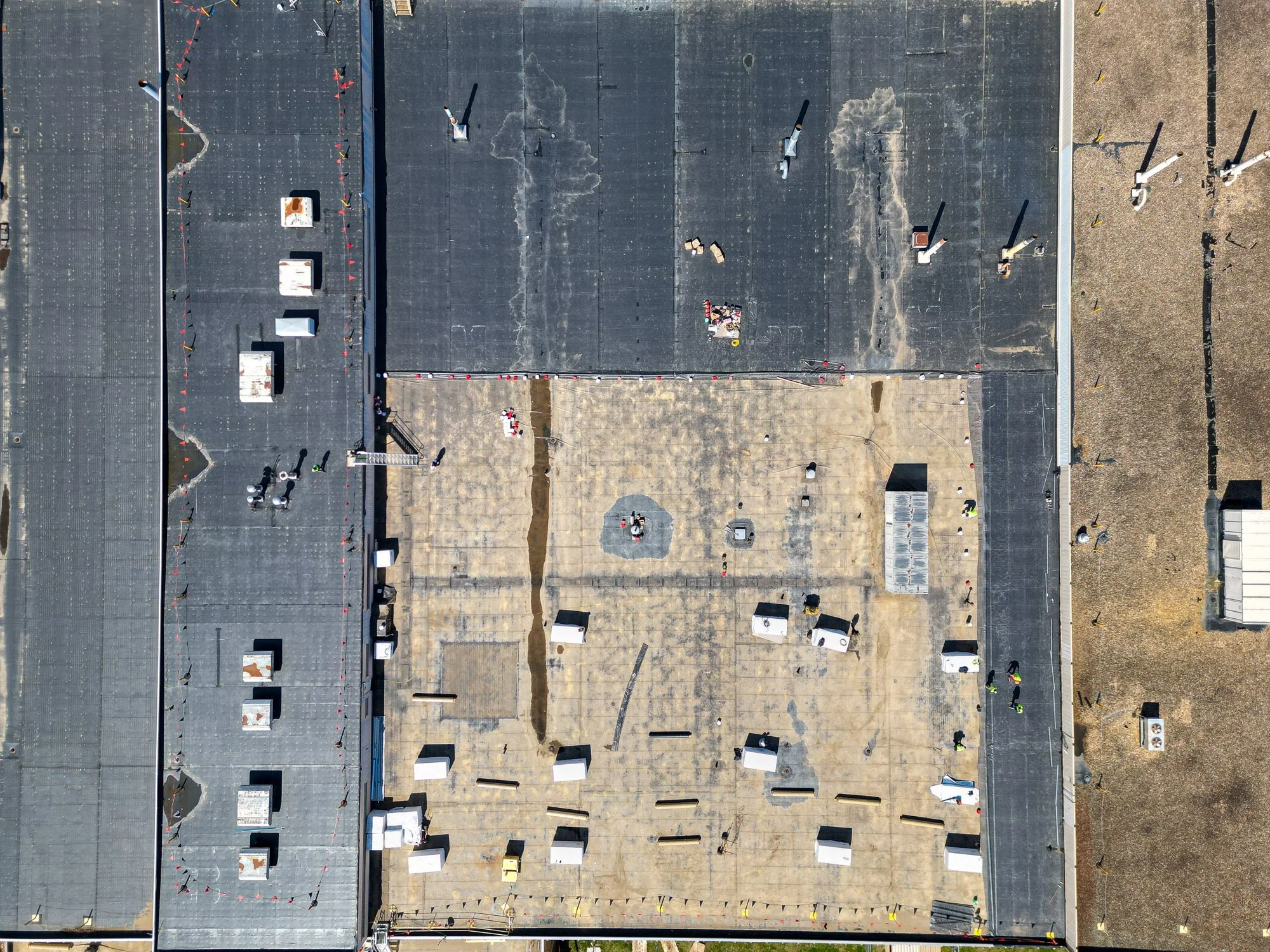
The St Louis Ballasted Roof Population
The commercial building stock in Chesterfield, west St Louis County, and the older suburban office parks east of I-270 includes a substantial number of ballasted EPDM roofs installed between 1975 and 1990. These are typically single-story or two-story office park buildings, light-industrial facilities, and retail properties, structures with flat or near-flat concrete or steel decks that were appropriate for ballasted application at their original structural design.
Clayton's older office buildings, particularly the towers and mid-rise structures built in the 1970s on the Forsyth and Bemiston corridors, also include ballasted systems that are now approaching 40 years in service. The structural load from 10 to 15 pounds per square foot of aggregate adds up on older high-rise structures, and any ballasted-roof replacement scope must include a structural review to confirm the deck can support both the existing ballast and the replacement system's design loads. We include that structural review referral as a standard element of the assessment on any high-rise ballasted system.
Ballasted System Assessment: What We Look For
Aggregate condition: Ballast stone should be clean, rounded, and 1.5 to 2.5 inches in diameter. Over decades, aggregate becomes embedded in deteriorated membrane, shifts to low areas around drains, and accumulates organic debris that retains moisture. We assess aggregate condition and distribution during inspection. Heavily migrated or contaminated ballast affects the drainage pattern and the stability of the membrane below the low-ballast zones.
Membrane seam condition: Ballasted EPDM seams are lapped and adhered, like any EPDM system. We move aggregate in representative zones to expose seam locations and visually inspect seam condition and tape integrity. On 35-to-40-year-old ballasted systems, seam tape adhesive that has dried and cracked is the most common failure mode. The membrane field may be intact while the seams have lost their adhesive bond and are allowing water infiltration that the ballast conceals.
Drain flashing condition: Drains in ballasted systems are typically gravel guards or domed strainers mounted in cast-iron or plastic drain bodies. The flashing collar between the drain body and the membrane is the highest-risk detail in a ballasted system. We remove drain covers, inspect the collar condition and clamping ring torque, and assess the drain body condition. Cast-iron drain bodies from 1970s construction are frequently corroded at the clamp ring interface and need replacement before any new membrane is installed.
Ballasted Replacement Options
When a ballasted system reaches end of life, the replacement path requires a structural decision first: does the deck support another ballasted system, or should the replacement use a mechanically attached or fully adhered system that eliminates the ballast load? For older buildings in Chesterfield and west county that are already carrying 40 years of original ballast load, we recommend structural review before specifying a ballasted replacement. The cumulative load from decades of freeze-thaw aggregate migration to drain basins can create concentrated loads the structure was not designed for.
Mechanically attached TPO or EPDM is typically the right replacement specification for buildings where eliminating the ballast load is desirable or where the deck cannot support a new ballasted system. The tear-off scope includes aggregate removal, which is a significant labor cost element, and membrane and insulation removal down to deck. New mechanically attached TPO on tapered polyiso insulation with a high-density cover board is a straightforward replacement that resets the asset for 20 years.
For buildings where the structural load is not a constraint and the owner prefers the low-maintenance profile of a ballasted system, a new loose-laid EPDM with fresh aggregate is a legitimate replacement option. New ballasted systems are less common today than in the 1980s because mechanically attached single-ply has become more cost-competitive, but they remain a valid specification for specific building types and owner preferences.
Derecho Wind Performance of Ballasted Systems in St Louis
The question that every St Louis building owner with a ballasted roof should understand is wind-uplift performance during derecho events. Ballasted systems resist wind uplift through aggregate weight, not fastener resistance. The design aggregate weight, typically 10 to 12 psf of loose stone, was specified against the design wind speed at the time of construction. St Louis's documented derecho events have produced peak gusts above 80 mph over large commercial areas in the metro, concentrated on the Missouri River floodplain and near Lambert Airport.
On buildings with standard 10-psf ballast at perimeter and corner zones, derecho-level gusts can move aggregate from perimeter zones and expose membrane edges, where wind uplift force is highest. After any significant wind event, ballasted roofs should be inspected for aggregate migration at perimeters and corners. Restoring perimeter aggregate depth is the maintenance action that keeps the wind-uplift design intact. Perimeter pavers, heavier than aggregate and less mobile, are the appropriate specification for the high-uplift zones on buildings with documented derecho exposure along the Missouri River corridor.
Aggregate Removal and Disposal Costs
Aggregate removal adds materially to the tear-off cost on a ballasted system compared to a conventional single-ply tear-off. Removing two to four inches of river gravel from a 50,000-square-foot roof requires vacuum equipment, heavy haul containers, and significantly more crew time than membrane and insulation removal alone. That cost is real and should be understood before the ballasted system is assessed as a replacement candidate.
Because the aggregate removal cost is substantial, we include it as a specific line item in every ballasted replacement scope we deliver. The total cost of a ballasted tear-off and replacement is typically 20 to 35 percent higher per square foot than a mechanically attached single-ply replacement of equivalent insulation spec, and the aggregate removal is the primary driver of that difference. For many owners in the St Louis market, this cost difference further supports converting to a mechanically attached replacement system rather than reinstalling a ballasted system on the next cycle.
Structural Load Considerations on St Louis Office Buildings
Clayton office towers and west county office parks from the 1970s present a specific structural challenge when their ballasted systems approach end of life. The original structural design accounts for the ballast dead load, but decades of aggregate migration and potential insulation saturation have changed the load distribution on the deck. Before any recover or replacement scope is written, a structural review confirms whether the existing framing can support the next system's design loads.
We engage a licensed Missouri structural engineer on any ballasted replacement project where the building is high-rise, where the existing ballast weight significantly exceeds the original design value due to migration accumulation, or where the owner has no documentation of the original structural design capacity. The structural review is a required step before we commit to a scope, and the engineer's clearance documentation is included in the project file. That documentation protects the building owner from discovering a structural deficiency after the new membrane is installed.