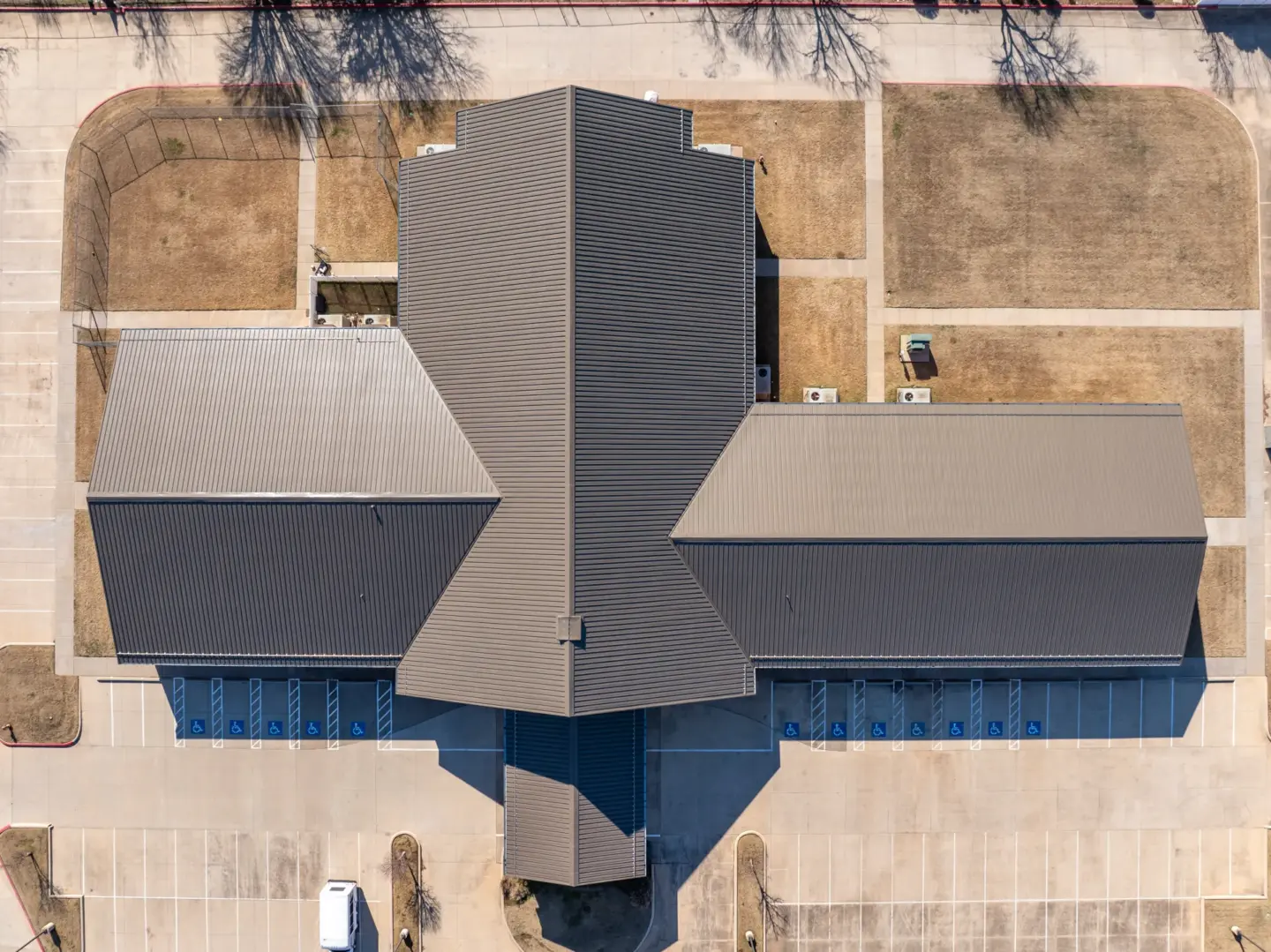
Panel Material and Finish Selection
Galvalume steel, 55 percent aluminum, 43.4 percent zinc, and 1.6 percent silicon-coated steel, is the standard panel material for St Louis commercial standing seam installations because it combines corrosion resistance, hail resistance, and cost-effectiveness. On a St Louis commercial roof that will see periodic hail events, Galvalume at 24-gauge provides meaningful dent resistance compared to 0.032-inch aluminum. We specify Galvalume steel as the default for commercial applications in the metro and move to aluminum only where the design calls for it.
PVDF coating, sold under the Kynar 500 and Hylar 5000 trade names, is the standard finish for commercial standing seam in St Louis. PVDF finishes carry 30-year chalking and fading warranties from major manufacturers and hold their color through the UV exposure and temperature cycling that the St Louis climate produces over decades. Field-coated or polyester-finished panels are not specified for commercial applications. The finish life does not match the panel life, and the mismatch creates a maintenance issue in year 15 that defeats the purpose of the standing seam investment.
Clip Systems and Thermal Movement
The temperature range that St Louis standing seam roofs experience, from approximately negative 10 degrees Fahrenheit on the coldest January nights to 160 degrees Fahrenheit or above at panel surface temperature on a July afternoon, produces significant thermal expansion and contraction across a large roof. A 100-foot-long Galvalume panel will expand and contract approximately three-quarters of an inch across that temperature range. The clip system must accommodate this movement without binding. A fixed clip on a long panel run will buckle the panel in summer or crack the seam in winter under thermal constraint.
We specify floating clips on all commercial standing seam installations and size the clip spacing and slot dimension to the specific panel run length and temperature range for the St Louis application. On long-run panels above 40 feet, we use two-piece clips that allow full thermal travel. The design detail matters. Inadequate clip travel allowance is the primary cause of seam splitting on St Louis standing seam roofs that are five to ten years old, and it is a failure mode that is entirely avoidable with correct engineering.
Standing Seam on Clayton Class A Office Buildings
Several of the older and more architecturally prominent office buildings on the Forsyth Boulevard corridor in Clayton carry standing seam metal roofs as part of their original design. These roof systems are a building character element worth preserving and maintaining rather than replacing with a generic single-ply recover. Restoration of aging standing seam on a Clayton Class A building involves panel condition assessment, re-seaming of opened seams, clip inspection and replacement where binding has damaged the seam, and re-coating with a PVDF or acrylic elastomeric system where the original finish is chalked or oxidized but the panel substrate is sound.
Where panel damage from hail or mechanical impact is concentrated in specific zones, selective panel replacement can be executed without disturbing the surrounding roof. We assess existing standing seam systems with the same moisture documentation protocol we use on flat roofs: condition of the underlayment and insulation below the panels is as important as the panel condition itself. A standing seam system with deteriorated underlayment is not a restoration candidate until the underlayment is addressed.
Insulation and Underlayment Systems
Standing seam metal systems require a properly designed underlayment and insulation stack beneath the panel to prevent condensation on the underside of the panel, control thermal bridging through the clip system, and provide adequate substrate for clip attachment. In St Louis buildings, where the dew point difference between interior and exterior can be significant in both summer and winter, vapor barrier placement is a design input, not an afterthought.
For retrofits over existing low-slope roofs, the insulation stack typically includes an existing membrane that serves as the vapor control layer, rigid polyiso insulation to the required R-value, a protection board, and the standing seam clip-attachment plane. Designing the retrofit stack to the specific building's thermal requirements, not to a generic spec pulled from a warmer climate, is the work that separates a 40-year installation from one that develops condensation problems in year three.
Hail Performance and St Louis Spring Storm Season
The St Louis metro sees hail-producing thunderstorms from April through October, with the highest-frequency events concentrated in May and June. Hail events in the 1-inch to 1.5-inch range, which are the most common significant events, dent 26-gauge and lighter aluminum panels and can cause cosmetic damage that reduces the building's insurance position even when functional waterproofing is maintained. Galvalume at 24-gauge is significantly more hail-resistant for the hail sizes this market produces.
Dents in standing seam panels do not necessarily compromise waterproofing. The standing seam panel is the waterproofing element at the seam, and dents in the flat panel field typically do not affect seam integrity. However, dents at the seam line itself can cause seam separation over time under the thermal movement that the St Louis climate produces, and those should be assessed after a major hail event. We provide post-hail standing seam assessments for buildings on our maintenance programs, with written documentation that distinguishes cosmetic panel denting from functional impairment.
Lifecycle Cost Analysis and Building-Specific Math
The business case for standing seam metal in St Louis comes down to the lifecycle cost comparison: one 40-year installation versus three 15-year single-ply cycles including tear-off, disposal, and escalating labor and material costs. For a building the owner plans to hold for 40 years, the standing seam math is favorable when the annual cost is calculated rather than the upfront installed cost. For a building the owner plans to sell in 10 years, the premium does not work in their favor.
We run the lifecycle cost comparison as a written deliverable on every standing seam scope we produce. The comparison uses the building's actual roof area, the current installed cost for both systems in the St Louis market, an inflation assumption on future replacement costs, and the maintenance cost differential between a standing seam system and a single-ply program. The comparison is specific to the building, not a generic industry claim, and it is the basis on which the owner makes the specification decision with their capital planning team.