Roof Systems

Spray Polyurethane Foam Roof Systems in St Louis

Spray polyurethane foam SPF roofing combines insulation and waterproofing in a single seamless application. The right system for complex roof geometries, buildings with high energy-code insulation requirements, and structures where eliminating every seam and fastener is the primary performance goal in a market with 18 to 22 freeze-thaw events per year.

Roof Systems

Spray Polyurethane Foam Roof Systems in St Louis

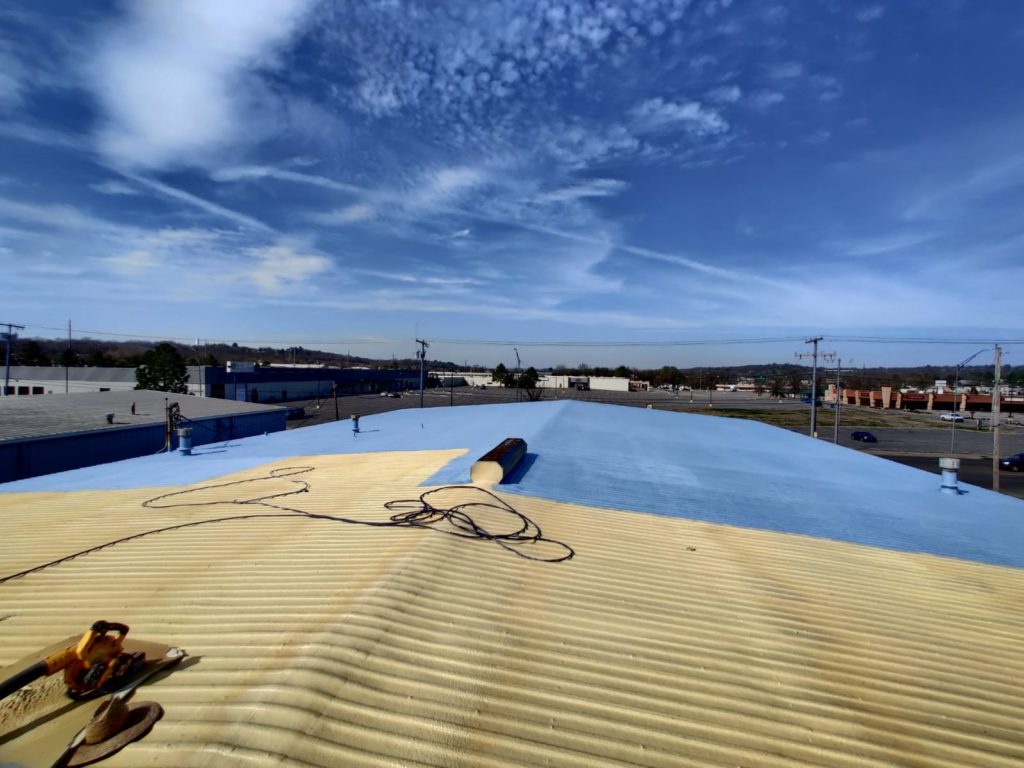
Spray polyurethane foam roofing builds up in place. Liquid isocyanate and polyol components are mixed at the spray gun and expand on contact with the substrate to a closed-cell foam that is both the insulation layer and the waterproofing substrate. A protective elastomeric coating, typically silicone, is applied over the cured foam to protect it from UV degradation. The result is a roofing system with no seams, no laps, no fastener points, and no locations where freeze-thaw cycling can work a joint open.

In the St Louis market, SPF is most often specified on buildings with complex roof geometry that defeats the neat application of single-ply membrane: multiple levels, dormers, extensive penetrations, or irregular parapets where every membrane seam is a potential failure point. The seamless nature of foam eliminates every seam as a failure mode, which is a significant advantage on buildings where the flashing complexity would make a single-ply system's seam network difficult to install and maintain over 20-plus years.

SPF is also the highest-R-value roof insulation system available in a single application. Closed-cell SPF runs R-6 to R-7 per inch compared to R-5 per inch for polyiso. For St Louis commercial buildings that need to meet current Missouri energy code insulation requirements on a shallow existing deck profile, SPF can achieve the required R-value in less total thickness than a conventional insulation stack, which matters when parapet height limits the available insulation depth.

Spray Polyurethane Foam Roof Systems in St Louis

Scope clarity

What the written scope needs to settle

Spray polyurethane foam SPF roofing combines insulation and waterproofing in a single seamless application. The right system for complex roof geometries, buildings with high energy-code insulation requirements, and structures where eliminating every seam and fastener is the primary performance goal.

The written recommendation should separate immediate water-control work, system-level defects, drainage concerns, warranty limitations, access constraints, and capital timing so ownership can decide without guessing.

Foam Density and Specification for St Louis Buildings

Commercial SPF roofing is specified at 2.0 to 3.0 pounds per cubic foot density. 2.0 pcf foam is the standard commercial roofing specification, adequate structural strength for normal maintenance traffic, appropriate closed-cell content for roofing waterproofing, and the most cost-effective density for large commercial applications. 3.0 pcf foam provides better compressive strength for high-traffic or equipment-bearing areas but costs significantly more per board-foot.

For most St Louis commercial SPF applications, we specify 2-inch minimum foam thickness over the entire field and 3-inch thickness at drains and low areas where standing water accumulates. The increased thickness at low areas adds insulation value at the most thermally vulnerable points, drain flanges and adjacent insulation are where thermal bridging is most concentrated in conventional insulation systems, and provides additional impact resistance in zones where rooftop maintenance traffic concentrates.

Silicone Topcoat Selection for the St Louis Climate

Silicone coating is the standard protective topcoat for SPF roofing in St Louis because silicone tolerates ponding water, a relevant property on a foam roof that may have low areas collecting water, and maintains UV resistance through the temperature cycling the metro produces. St Louis surface temperatures on dark roofs exceed 160 degrees Fahrenheit on July afternoons, and the UV load that silicone must resist is substantial across the long Missouri summer season.

Silicone over SPF is also renewably warranted. At the end of the warranty term, a clean, prepare, and recoat scope extends the warranty without foam replacement. Acrylic elastomeric coatings are an alternative where ponding is not a concern and cost is a constraint, but we do not specify acrylic over SPF on St Louis commercial buildings where chronic ponding has been documented. Acrylic in continuous ponding contact softens and loses adhesion to the foam substrate, a failure that looks like coating delamination but is actually a specification mismatch.

Application Conditions and Seasonal Constraints

SPF requires specific application conditions: substrate temperature above 50 degrees Fahrenheit, relative humidity below 85 percent, and wind below 15 mph at the spray height. In St Louis, these conditions constrain the application window. Spring and fall offer the most consistent conditions. Summer in St Louis can produce afternoon humidity above 85 percent and high temperatures that affect foam rise rate, and winter temperatures frequently drop below the substrate requirement through November and February.

We monitor conditions hourly during SPF application and stop work when conditions move outside the acceptable range. Foam applied in high humidity produces a friable, chalky surface that does not bond adequately to the subsequent lift or to the protective coating. We do not produce marginal foam to meet a construction schedule. The foam quality on the first pass determines the quality of every pass on top of it, and a coating applied over compromised foam will fail at that layer regardless of the coating quality.

SPF for Institutional Campus Buildings

Washington University in St Louis campus buildings, particularly the older academic buildings in the Danforth campus core, frequently have complex slate-and-flat roof profiles with parapet geometries and penetration densities that complicate single-ply application. SPF has been applied successfully on several St Louis institutional campus buildings precisely because it conforms to complex geometry without field-fabricated flashings at every transition. The foam can be built up around penetrations, shaped to create positive drainage toward existing drains, and detailed at parapets with a continuous termination that requires no separate flashing membrane.

Institutional building SPF specifications often require coordination with the campus facilities department on coating color, institutional owners sometimes have specific reflectance or aesthetic requirements, and on the staging logistics of working within a dense campus environment. We plan institutional campus SPF projects the same way we plan medical campus work: pre-construction coordination, staged access, and a sequencing plan that accounts for building occupancy and foot traffic around the work zone.

SPF Candidacy Assessment: When It Works and When It Does Not

SPF is not the right system for every St Louis commercial building, and we assess candidacy in writing before recommending it. A sound, dry, mechanically stable substrate is required. SPF cannot be applied over wet insulation, loose aggregate ballast, or corroded metal deck. Buildings without positive drainage cannot be fully corrected by SPF tapering alone if the structural deck is flat and the drain layout is fundamentally inadequate. And high-traffic rooftops where maintenance personnel cross frequently can abrade the silicone topcoat in ways that require more frequent maintenance than a TPO walkway pad system would.

For buildings where SPF is a strong candidate, the assessment covers substrate moisture content via core sampling, structural deck condition via inspection ports, existing penetration count and condition, and rooftop traffic frequency and pattern. The written assessment report includes a cost comparison between SPF and the alternative single-ply system for the specific building so the owner can make the decision with comparable data rather than a general claim about SPF's performance advantages.

Energy Code Compliance and SPF Advantages

Missouri's adoption of the IECC sets minimum insulation values for commercial roofing assemblies. SPF's R-6 to R-7 per inch closed-cell foam achieves the required R-value in less total thickness than a polyiso stack, which is a direct advantage on buildings where parapet height or mechanical clearance limits the available insulation depth. The continuous insulation that SPF provides eliminates the thermal bridging pathways that exist at every mechanical fastener in a mechanically attached single-ply system.

For St Louis commercial buildings pursuing LEED certification or documenting energy performance under their corporate sustainability program, SPF's continuous insulation value is a measurable advantage in the energy model. We document the foam's R-value per inch and the installed thickness at closeout via core sampling, providing the compliance documentation that LEED submittals and energy code compliance reviews require. The documentation is in the closeout package alongside the silicone topcoat warranty certificate.


Start with evidence from the roof, then decide the repair, coating, recover, or replacement path.

Roof Questions

What owners usually need clarified

Does spray foam roofing work in St Louis winters?

The application window is limited by temperature and humidity requirements, but a properly installed SPF system performs through St Louis winters without issue. The closed-cell foam is impermeable to moisture infiltration and does not absorb water through freeze-thaw cycling, unlike open-cell foam or conventional insulation that can absorb and hold water. The limitation is on the application side, not the performance side. We schedule SPF production from March through October for most St Louis projects.

What happens if the foam is damaged or penetrated after installation?

Minor foam damage, screw punctures, small cuts from foot traffic, is repaired by cutting out the damaged foam, filling with compatible foam, and recoating with the protective coating. The repair is nearly invisible in the final result. Major damage from equipment impact requires section replacement. SPF is repairable in place without affecting surrounding areas, unlike membrane systems where a patch introduces a new seam that requires probe-testing and ongoing maintenance.

Can SPF be applied over an existing commercial roof in St Louis?

Yes, and this is a common application. Foam can be applied over EPDM, TPO, modified bitumen, BUR, or existing foam, provided the substrate is dry and properly prepared. Moisture-core sampling before foam application is mandatory. Foam applied over wet insulation traps moisture and prevents drying, accelerating deck deterioration below. The substrate must be dry, mechanically sound, and free of loose material before foam application begins.

How does SPF handle the derecho wind events that cross the St Louis area?

SPF's primary wind advantage is that it is a fully adhered seamless system with no point-loaded fasteners and no seam zones to peel. Wind uplift on an SPF system acts on the foam-to-substrate bond rather than on individual fasteners, and the bond strength is typically higher than the foam's tensile strength. Properly installed SPF on a sound substrate holds well under the straight-line wind events that affect the Earth City and Hazelwood corridors. The perimeter termination detail is the critical wind-resistance element and is designed for the building's actual wind uplift zone.

Related Roof Decisions

Keep the conversation connected

These pages cover nearby roof questions owners often need to resolve before a final scope moves forward.

Roof Systems

Ballasted Roof Systems in St Louis

Ballasted flat roofs, loose-laid membrane weighted with river-washed stone or concrete pavers, represent a significant portion of the 1970s and 1980s commercial building stock in St Louis County and Chesterfield. We.

Roof Systems

Built-Up Roof Systems in St Louis

St Louis has more original BUR stock still in service than most Sun Belt markets. Older masonry commercial buildings Downtown, in Midtown, and along the south city industrial corridor have carried asphalt and aggregate.

Roof Systems

Cool Roof Systems in St Louis

St Louis commercial roof surface temperatures exceed 160 degrees Fahrenheit on dark membranes in July. Reflective cool-roof systems reduce that surface temperature by 50 to 80 degrees Fahrenheit, cutting cooling loads.

Services

Commercial Roof Inspections in St Louis

A roof inspection from our team is a written condition report, not a verbal summary. We document what we find, membrane condition, flashing failures, drain status, penetration detail integrity, with photos keyed to a.

Roof Systems

TPO Roof Systems in St Louis

Thermoplastic polyolefin is the volume-grade flat-roof membrane for the St Louis commercial market. We install TPO on mechanically attached, fully adhered, and induction-welded configurations, each scoped to the.

Capabilities

Roof Condition Reporting, St Louis Commercial Buildings

Condition reports are the foundation of every capital decision we support. We produce written, photo-keyed reports that give St Louis building owners a zone-by-zone picture of the roof's current state, not a verbal.