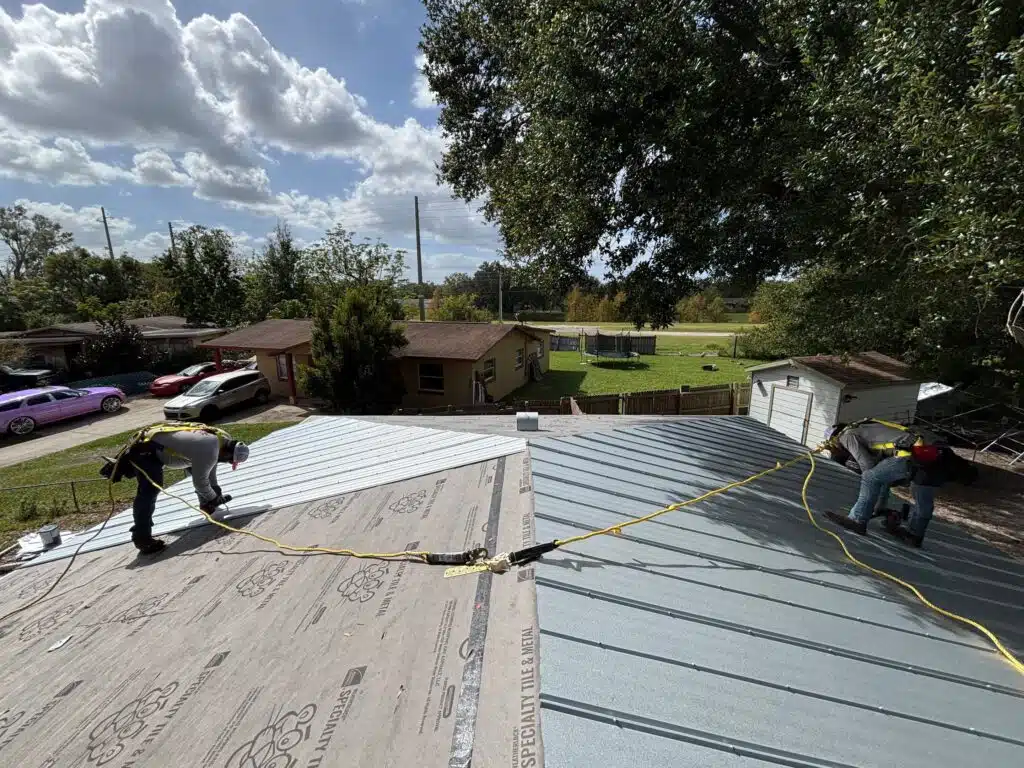
System Types, Mechanically Seamed vs Snap-Lock
Mechanically seamed panels: The seam is folded and compressed mechanically after installation, creating a continuous interlocked joint that runs the full panel length. Stronger seam profile, the standard specification for steep-slope applications and for buildings in high wind-exposure zones. A derecho event that tracks across the St Louis metro produces the kind of sustained straight-line wind loading that separates mechanically seamed panels from snap-lock installations on large industrial roofs.
Snap-lock panels: The panel seam snaps together without a mechanical seaming operation. Faster to install, lower labor cost, appropriate for moderate slope applications and buildings in standard wind-exposure zones. The tradeoff is seam uplift resistance, snap-lock systems have lower wind-uplift ratings than mechanically seamed systems at equivalent fastener patterns. We specify mechanically seamed panels on any St Louis building where the roof zone or exposure category generates uplift loads above what snap-lock systems are rated for.
Clip attachment: Both system types attach to the substrate through concealed clips that float the panel over the framing. The floating clip accommodates thermal expansion and contraction, critical in St Louis's climate, where the surface temp differential between a January night and an August afternoon can span 160°F. Fixed-point attachment of metal panels produces the oil-canning and seam stress that leads to joint failure over time. We size the clip-spacing and panel profile to the building's thermal expansion load.
Panel Materials, Galvalume vs Aluminum
Galvalume (steel with aluminum-zinc alloy coating) is the standard substrate for most St Louis commercial standing seam work. It handles the structural loads of a large commercial roof, tolerates foot-traffic during maintenance better than aluminum, and carries paint systems (PVDF/Kynar) that hold color and corrosion resistance for 30-plus years. Galvalume is the cost-effective choice for industrial and warehouse buildings where the long-term performance matters more than weight.
Aluminum panels are the right specification for buildings near the Mississippi River corridor or any building in a micro-environment with elevated moisture exposure, aluminum does not rust, and on a building in a flood-prone or high-humidity zone, the corrosion differential over a 40-year service life is meaningful. Aluminum is also lighter, which matters on buildings where the structural framing has limited additional dead-load capacity. The tradeoff is cost, aluminum costs more per square than Galvalume, and a somewhat lower structural panel strength at equivalent gauge.
PVDF paint systems are what we specify on both substrates. Polyvinylidene fluoride coatings (marketed as Kynar 500 by Arkema) are the industry standard for exterior metal performance, chalk-resistant, UV-stable, and capable of 40-year color retention. We do not specify polyester paint systems on commercial work. The color savings over PVDF are real; so is the chalk, fade, and corrosion differential at year 15.
Standing Seam Over Existing Low-Slope Roofs
One of the more practical applications of standing seam in the St Louis market is the retrofit installation over an existing low-slope membrane system. A building with a marginally sloped built-up or TPO roof that is approaching end of life can be reroofed with a standing seam system over a structural sub-framing layer that creates positive slope, eliminates ponding water, and provides 40-plus years of service life, without a full tear-off of the existing membrane.
The sub-framing adds dead load to the building's structural deck, so we require a structural engineer to review the existing deck capacity before specifying a retrofit framing approach. On most post-1970 St Louis commercial buildings with concrete or metal decks, the additional load is within capacity. On older buildings, pre-war masonry construction in the South City industrial corridor or older warehouses in the Soulard district, the structural review is the project gate that determines whether a retrofit standing seam is viable.
The appeal for St Louis building owners is real: the existing roof stays in place (reducing disposal cost and avoiding the risk of opening the deck during a St Louis spring storm season), the new standing seam system provides a 40-year-plus roof, and positive drainage eliminates the ponding-water problem that drove the original reroofing decision. We have used this approach on distribution and warehouse buildings in the St Louis County industrial corridors where the owner needed a 40-year solution without the disruption of a full tear-off.
Freeze-Thaw and Wind Performance in the St Louis Climate
St Louis averages 18 to 22 freeze-thaw cycles annually, temperature crossings through 32°F that expand and contract the panel substrate and the framing below it. Metal roofing handles this well when the clip system is designed for thermal movement. The failure mode we see on older or improperly specified standing seam systems in the metro is seam distortion from inadequate clip-slot length, the panel cannot float freely at temperature extremes and the accumulated stress eventually opens the seam.
Derecho wind events are the other St Louis-specific performance test. A significant derecho crossing the metro produces not just sustained high winds but rapid pressure changes that cycle uplift loads on the panel seams multiple times in a short period. Mechanically seamed panels on properly spaced clips handle this load without seam opening. Snap-lock panels on the perimeter zones of a large roof, where uplift loads concentrate, are the vulnerability point. We specify mechanically seamed perimeter panels even on snap-lock field-panel installations where the building's wind-uplift zone warrants it.
Standing Seam Metal at Lambert Airport and Hazelwood Corridor Buildings
Institutional and government-adjacent commercial buildings in the Lambert Airport corridor, including the aerospace defense facilities in Hazelwood and Berkeley, have specified standing seam metal systems for specific reasons: the 40-plus-year service life reduces long-term capital event frequency, the non-penetration solar panel racking option accommodates facility modernization without warranty complications, and the clip-based floating attachment accommodates Missouri's full temperature range without fastener stress.
We specify standing seam systems for Hazelwood and Maryland Heights corridor commercial buildings with the specific thermal movement calculation appropriate to Missouri's design temperature range. The annual differential between a January low near zero degrees and a July peak near 100 degrees drives panel movement that must be accommodated in the clip pattern and the panel fixed-point design.