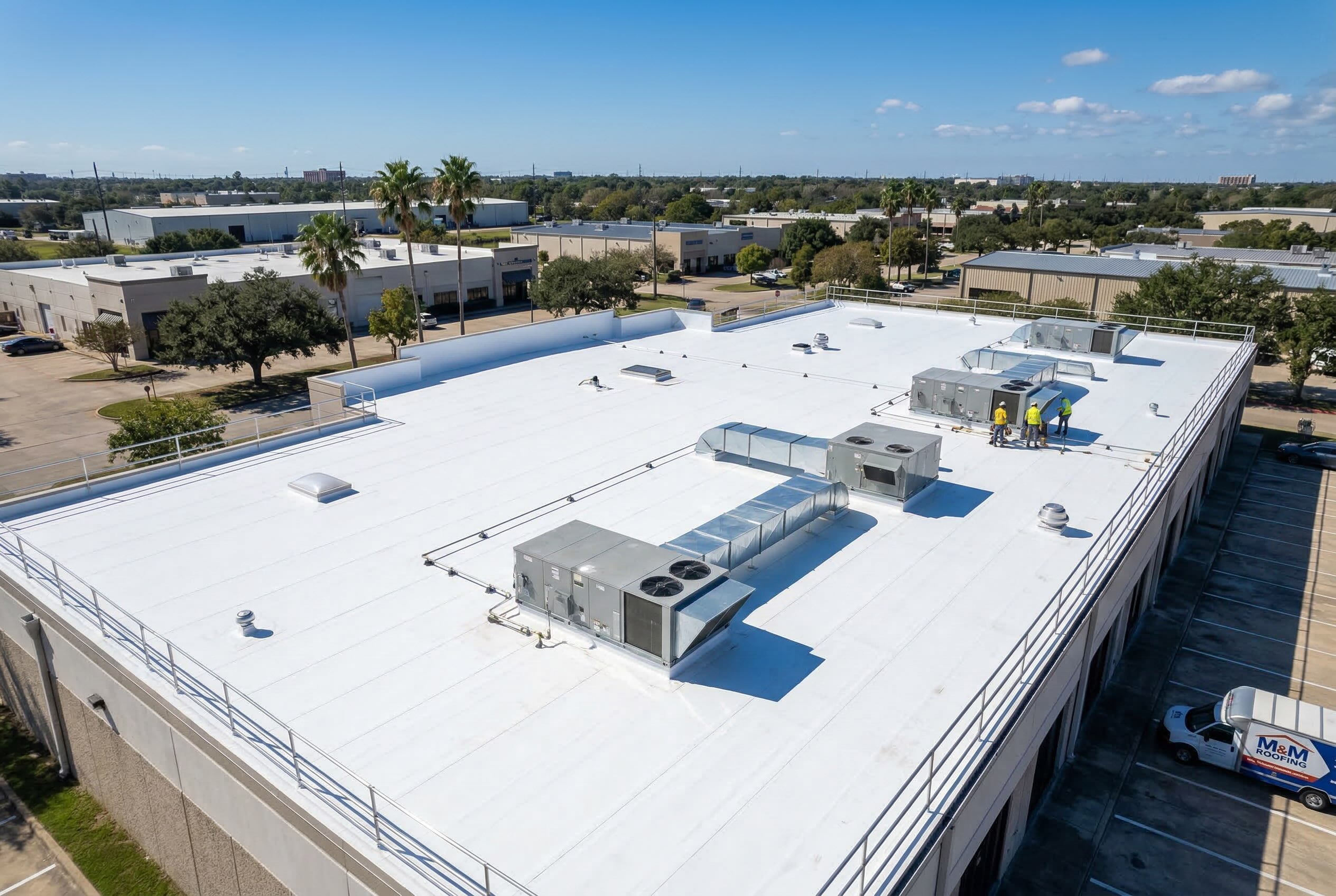
Single-Ply System Selection in the St Louis Market
TPO: The default specification for most St Louis commercial flat roof replacement and recover projects. White or light-grey TPO reduces summer surface temperatures from above 160°F (on dark EPDM) to 80 to 100°F, a significant cooling-load reduction for any building with rooftop HVAC. Heat-welded seams are more reliable than adhesive-bonded EPDM seams when properly installed and tested. 60-mil carries a 20-year manufacturer NDL warranty; 80-mil extends that to 25 years from some manufacturers. We specify 60-mil TPO as the standard on most St Louis commercial work, and 80-mil on high-traffic roofs and buildings where the longer warranty term is a capital planning requirement.
EPDM: The legacy system on a substantial portion of St Louis's existing commercial roof stock. Cold-weather flexibility is EPDM's defining advantage in a freeze-thaw market, the membrane field rarely fails from cold-weather stress, though seams and flashings require regular maintenance. Black EPDM carries a heat penalty in summer that makes it less appropriate for occupied commercial buildings with significant cooling loads. For Earth City industrial warehouses, the Hazelwood manufacturing corridor near STL airport, and large distribution facilities where cooling load is not a primary driver, EPDM remains a competitive lifecycle choice.
PVC: The chemical-resistance specification. Anheuser-Busch's main campus in Soulard, restaurants throughout the Downtown entertainment district and near Busch Stadium and the Enterprise Center, and medical facilities on the BJC HealthCare and SSM Health campuses are the primary PVC applications in the St Louis market. PVC costs more per square than TPO or EPDM and is not the right specification for buildings without chemical exposure, but on buildings where the chemistry is present, it is the correct specification regardless of cost premium.
Single-Ply Performance in the St Louis Climate
Freeze-thaw cycling: St Louis averages 18 to 22 freeze-thaw cycles per year, temperature movements through the 32°F threshold. The 1993 Mississippi River flood and subsequent severe weather history of the region have made building owners in this market more aware of moisture management than their Sun Belt counterparts. Single-ply membrane itself handles freeze-thaw cycling well when properly installed. What fails in freeze-thaw environments is the system's weakest details: parapet cap flashing sealant, base flashing transitions, penetration collars, and drain interfaces. Our installation details address every one of those points to manufacturer specification, and our maintenance programs inspect them on a bi-annual cadence.
Derecho wind exposure: Derecho systems crossing the Missouri Valley produce straight-line winds well above 70 mph and peak gusts above 100 mph over large geographic areas. After the 2019 and 2022 derecho events that affected the St Louis metro, the pattern we saw was consistent: mechanically attached single-ply on large, open roofs in the Earth City and Hazelwood industrial corridors that was underspecified on fastener density failed at the field rows, not at the perimeter. We design every mechanically attached installation against the building's actual wind-uplift zone and verify the fastener pattern against IBC requirements before closing out the installation.
Summer heat management: White TPO's solar reflectance advantage over black EPDM is measurable in terms of building energy performance and rooftop equipment lifespan. For HVAC equipment mounted on dark EPDM roofs across the Chesterfield West County corporate corridor and the Edward Jones and Emerson Electric campus properties in Des Peres and Ferguson, the operating environment difference between a black and a white roof surface is significant across a 20-year service life.
Single-Ply Installation, What We Document at Closeout
Every single-ply installation we complete is closed out with a documented package: manufacturer warranty document (NDL or standard, as specified), photo-keyed roof zone diagram documenting the installation configuration and all flashing details, seam-test records (roller test and probe test on all linear feet of seam), fastener pattern documentation for mechanically attached systems, and the maintenance schedule required to keep the warranty active.
The closeout package is not a formality. For a building in the Centene Clayton campus, the Enterprise Holdings corporate real estate portfolio, or the Edward Jones Des Peres headquarters facilities, the roof closeout package is an asset record that the next facilities director, the next capital planning cycle, and the next roof contractor will need to understand the system's condition and warranty status without starting from scratch. We produce it accordingly.
Manufacturer warranty inspection: Most major single-ply manufacturer NDL warranties require a field inspection by the manufacturer's representative before the warranty is issued. We coordinate that inspection, correct any findings before the inspector leaves, and obtain the warranty document before the final payment application is submitted. We do not hand the owner a punch list and tell them to follow up with the manufacturer themselves.
Missouri Energy Code Compliance for St. Louis Single-Ply
Missouri's commercial energy code, aligned with ASHRAE 90.1, requires minimum cool-roof reflectance for low-slope commercial buildings in Climate Zone 4A, the zone covering St. Louis and most of the Missouri metro. White TPO and PVC membranes in standard commercial formulations satisfy the reflectance minimum, and we document the membrane's rated solar reflectance in the City of St. Louis and St. Louis County permit application packages as a standard part of pre-construction.
Missouri's Climate Zone 4A designation reflects St. Louis's mixed-humid climate, which is warmer and more humid than Nebraska's continental climate but cooler than the Gulf Coast. The cool-roof requirement in this climate zone addresses summer cooling load reduction, and the high-reflectance single-ply membrane that satisfies the code also delivers operational energy cost reduction for St. Louis commercial buildings that are cooling-load-dominated in the summer months.
Wind Uplift Design for Missouri's Severe Weather Exposure
St. Louis commercial buildings face wind uplift exposure from Missouri's severe weather pattern: the derecho events that track through the Mississippi River corridor, the tornado outbreaks that affect the eastern Missouri metro most springs, and the sustained wind events associated with the cold fronts that cross the region regularly from October through April. We calculate wind uplift design for every St. Louis single-ply project using the building's specific ASCE 7 exposure classification and the Missouri design wind speed data.
Buildings in the Lambert Airport corridor, on the western suburban mesa terrain in the Chesterfield and Wentzville growth corridors, and in the open-terrain industrial zones south of downtown St. Louis face Exposure C wind classification that requires significantly higher perimeter and corner fastener densities than urban sheltered buildings. We document the exposure classification and the attachment pattern design in the project closeout package so the installed system can be verified against the design basis.