When PVC Is the Right Specification
Grease and chemical exposure: PVC's defining advantage over TPO and EPDM in the St Louis restaurant market is its resistance to grease hydrolysis. A TPO or EPDM membrane with persistent kitchen exhaust grease deposits will show membrane softening and seam degradation within five to seven years, sometimes sooner in high-volume restaurants. PVC holds up to that exposure class and maintains its weld integrity at seams and at the kitchen exhaust flashing details where grease concentration is highest.
Medical and pharmaceutical facilities: SSM Health and Mercy Health facilities, the BJC HealthCare campus at Barnes-Jewish and Children's Hospital in Central West End, and Washington University Medical Center buildings carry HVAC exhaust chemistry that includes chemical disinfectants, pharmaceutical process compounds, and specialized cleaning agents. PVC's chemical resistance makes it the specification-grade choice for those facilities. When we work on medical campus roofs in CWE, we specify PVC on any building with confirmed chemical exhaust exposure.
Food and beverage industrial: The Anheuser-Busch main campus on Lynch Street in Soulard carries brewing process steam, CO2 vent exhaust, and cleaning chemical exhaust across its rooftop. Standard TPO or EPDM on those buildings would face accelerated degradation. PVC is the industry-standard specification for brewing and food production facilities, and it is what we recommend and install on those applications throughout the metro.
PVC Installation Methods
Mechanically attached: Most common installation method for large PVC commercial projects. Membrane fastened through the seam overlap with screws and plates into the deck on a wind-uplift-designed pattern. Fast to install and cost-competitive on large footprints. St Louis derecho exposure means we do not underspec the fastener density on mechanically attached PVC any more than we would on TPO or EPDM.
Fully adhered: PVC bonded to the substrate with PVC-compatible adhesive. Specified for high-wind-uplift applications and for buildings where the deck cannot tolerate additional fastener penetrations. Fully adhered PVC is also specified for applications where aesthetic uniformity is required, with no fastener rows visible through the membrane field.
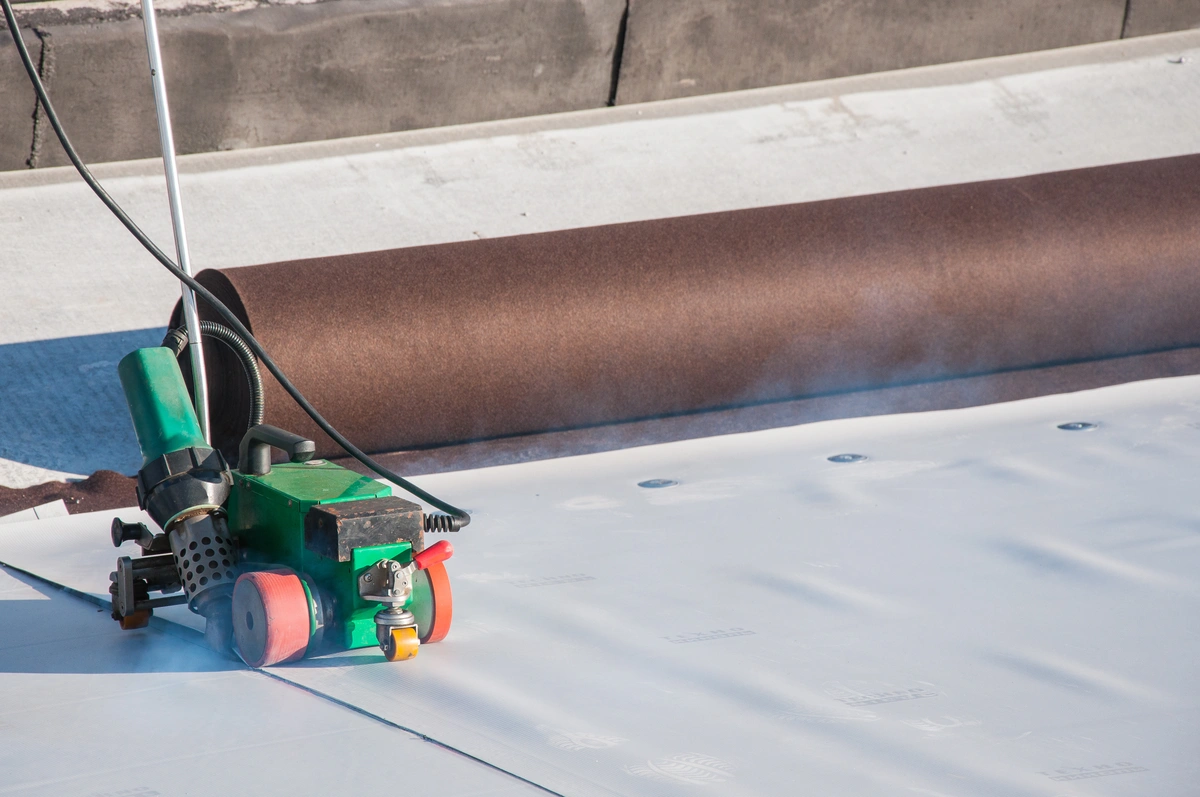
Duro-Last custom-fabricated: Duro-Last manufactures PVC systems as custom-fabricated assemblies with factory-welded seams. The field seam count is dramatically reduced compared to standard roll-goods installation. Most seams are made in factory conditions, not in field conditions on the roof. On complex roofs with high penetration counts or intricate flashing geometry, factory-welded assemblies reduce the risk of field-weld failure. The Duro-Last system is used on medical campus buildings and on food-service buildings throughout the metro where seam integrity is the primary performance requirement.
PVC Performance in the St Louis Climate
Freeze-thaw performance: PVC membrane is formulated with plasticizers that maintain flexibility in cold temperatures. Over time, plasticizer migration can cause older PVC membranes to become stiffer, a process that is accelerated by prolonged UV exposure. Modern PVC formulations are designed for better plasticizer retention, but PVC systems that are 20 or more years old should be assessed for cold-weather flexibility before another winter season. We include plasticizer-migration assessment in condition reports on aging PVC systems.
Seam longevity: PVC seams are heat-welded like TPO, and the weld quality at installation is the primary determinant of long-term seam integrity. Unlike TPO, PVC seams can be re-welded if the original weld is found to be inadequate. The thermoplastic chemistry allows field re-welding years after original installation, which makes PVC seam repairs more reliable than adhesive-repair approaches on EPDM.
Chemical Exposure Assessment Before Specifying PVC
Before specifying PVC on a St Louis commercial building, we document the specific chemical exposure profile at the roof surface. For restaurant applications, we identify the location and type of kitchen exhaust stacks, the frequency of grease discharge, and whether any existing membrane damage shows the characteristic softening and seam degradation pattern of grease hydrolysis. For medical facility applications, we review the HVAC exhaust chemistry documentation and confirm which chemicals are present at roof level.
This assessment determines whether PVC is the correct specification and, if so, which PVC product line best addresses the specific exposure. Some chemical exposures fall outside the resistance range of standard PVC formulations and require a specialty product or a different membrane class. We make that determination before the scope is written, not after the installation fails in its second season.
PVC Warranty Options in the St Louis Market
Most PVC manufacturers active in the St Louis market offer 20-year NDL warranty options on qualifying installations, with some manufacturers offering 25-year terms on premium system specifications. The warranty requires installation by a credentialed applicator, adherence to the manufacturer's published detail drawings at every flashing and termination condition, and a manufacturer field inspection before the warranty is issued. We hold credentials with the PVC manufacturers whose products we install and build to published details so the closeout inspection passes the first time.
For restaurant and medical facility applications where the chemical exposure creates above-standard warranty risk, we discuss warranty terms and limitations directly with the manufacturer before the project scope is written. Some manufacturers have specific warranty exclusions for chemical exposure that affect which coverage option is available. Building owners deserve to know the warranty terms that apply to their specific use case before they commit to a system, not after they need to file a claim.
PVC Recover and Replacement Scoping
PVC roofs approaching end of life can sometimes be recovered with a new single-ply system over existing PVC if the moisture core assessment confirms dry insulation and the existing membrane has adequate adhesion. However, chemical exposure applications require a more careful substrate assessment before a recover scope is recommended. If the existing PVC has experienced grease infiltration below the membrane surface, the substrate contamination can affect adhesion for the new system.
For buildings where PVC replacement is the right scope, we document the chemical exposure profile in detail for the replacement specification so the new system matches the building's actual use conditions. PVC replacements on Soulard food and beverage facilities and on Clayton and CWE medical campus buildings have specific flashing and penetration requirements related to process equipment and exhaust stack configurations that a generic single-ply replacement scope does not address. We write those details into the scope.