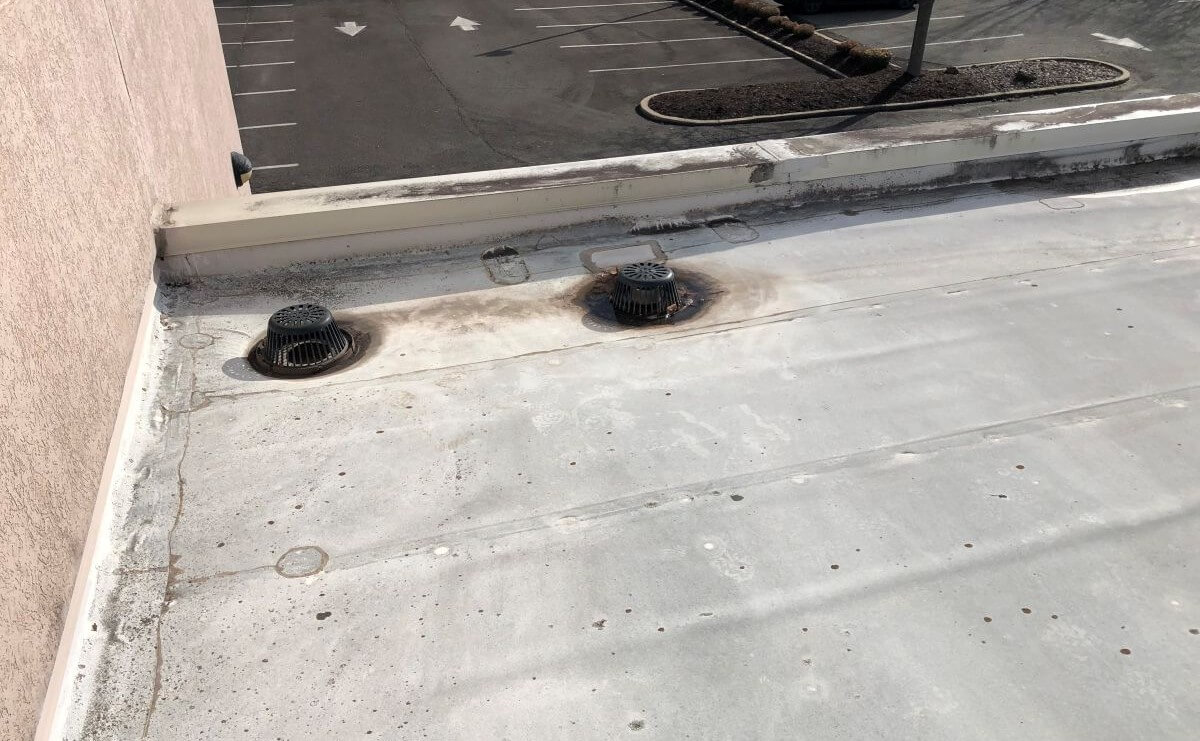
Drain Cleaning, What It Covers
Drain strainer cleaning is the first step: removing the strainer dome, clearing the debris accumulation, leaves, gravel, membrane granules, HVAC filter material, and whatever else the St Louis wind has deposited, and reinstalling the strainer or replacing it if the original is corroded or deformed.
Below the strainer, the drain bowl and the drain body itself can accumulate debris that the strainer does not catch. We flush the drain body with water to confirm positive flow through the drain line connection. If flow is restricted or absent, we probe the drain body and the connection to the interior drain line to identify the obstruction.
Roof drain lines in commercial buildings, typically cast iron or PVC depending on building age and construction type, can collect sludge, debris, and in older Downtown St Louis buildings, corrosion flakes from aging cast iron. If we identify a drain line obstruction below the roof level, we flag it for the building's plumbing contractor, drain line clearing below the roof deck is outside our scope but needs to be addressed.
Drain Bowl and Strainer Replacement
Cast iron drain bowls on pre-1980 commercial buildings in St Louis are often corroded to the point where the strainer seat is compromised, the strainer no longer seats properly, which lets debris into the drain line, or the drain bowl flanges have separated from the membrane clamping ring, which lets water bypass the drain entirely.
We replace corroded or failed drain bowls with compatible new assemblies. The replacement requires cutting the membrane around the drain, removing the old bowl and clamping ring assembly, setting the new bowl, and re-flashing the membrane to the new clamping ring per the membrane manufacturer's drain flashing specification. The drain flashing is one of the most leak-prone details on any commercial roof, we perform it to specification and photograph it at closeout.
Strainer replacement alone, when the bowl is sound but the dome strainer is cracked, corroded, or deformed, is a simpler scope that restores the drain's debris-capture function without membrane work.
Overflow Drains and Secondary Drainage
Building codes require overflow drains or scuppers on commercial roofs, a secondary drainage path that activates if the primary drains are blocked and ponding water reaches the overflow threshold. Many older St Louis commercial buildings were constructed before current overflow drain requirements, or have had overflow drain maintenance neglected to the point where the overflows are also blocked.
We inspect and clear overflow drains as part of every drain service call. Blocked overflow drains are a code violation and a structural risk, if primary drains clog during a heavy rain event and the overflows are also blocked, there is no relief path for the accumulating water load.
For buildings without adequate overflow drainage, we assess whether scuppers can be added to the parapet, or whether interior overflow drains can be installed, and provide a recommendation with scope and cost band.
Ponding Water and Positive Drainage Restoration
A roof that drains correctly does not have persistent standing water 48 hours after a rain event. Persistent ponding indicates either a drain problem, a tapered insulation design problem, or a deck deflection that has created a low point where the original design did not have one.
Ponding water accelerates membrane deterioration. TPO and EPDM membranes in standing water degrade faster than in drained areas, UV is concentrated by water surface reflection, biological growth accelerates, and the membrane is in constant contact with the debris and chemical load that settles into ponded areas.
Where ponding is caused by a drain problem, we fix the drain. Where it is caused by inadequate taper in the insulation design, we scope a tapered insulation add-on package that creates positive drainage to the existing drains. We provide written documentation of the ponding pattern and the proposed correction so the owner can make an informed decision about the capital scope.
Pre-Storm Season Drain Management for Missouri Thunderstorm Exposure
Missouri's spring severe weather season, which peaks in April through June, delivers convective storms that can produce two to three inches of rainfall in an hour. Commercial flat roofs in St. Louis that have partially blocked drain systems from winter debris accumulation are at risk of significant ponding during these peak-intensity storms. Pre-storm season drain clearing in March or April, before the severe weather season peaks, is the maintenance practice that protects against this ponding risk.
We schedule spring drain cleaning visits on our St. Louis maintenance routes in March, targeting buildings in the industrial corridors, the commercial zones near Lambert Airport, and the suburban retail areas where winter wind and storm debris accumulate most heavily in drain strainers. Pre-cleaning documentation photographs the drain condition at the start of the visit and the cleared drain at completion, providing a dated record that confirms the cleaning was done before the Missouri severe weather season.