Service Areas

Commercial Roofing in Downtown St Louis

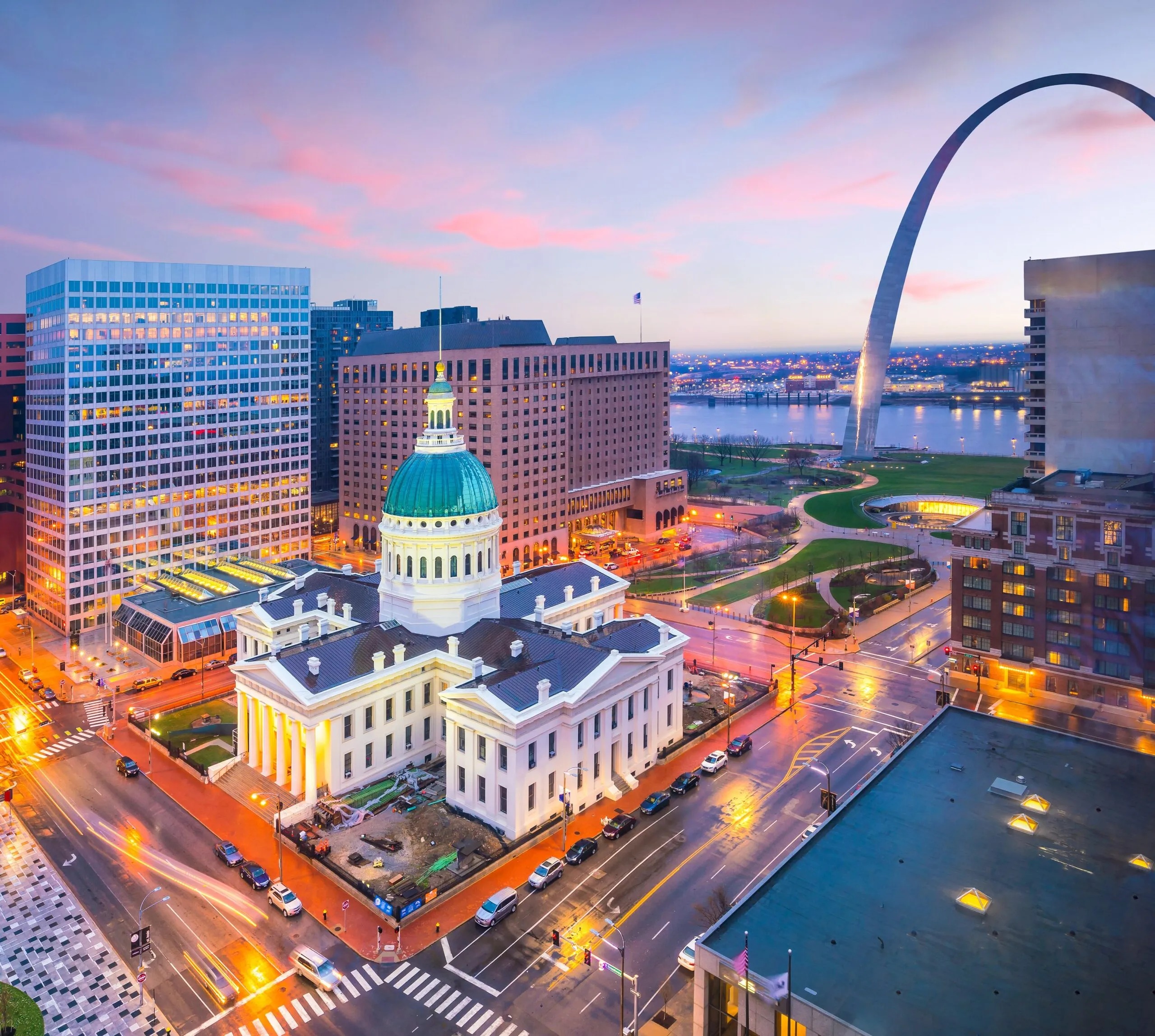
We serve commercial buildings across Downtown St Louis, the Gateway Arch district, the Busch Stadium and Enterprise Center event corridor, the Washington Avenue loft belt, and the older office towers along Tucker and Market that have been on two or three roofing cycles since they were built.

Service Areas

Commercial Roofing in Downtown St Louis

Downtown St Louis is a compressed inventory of building types. The Gateway Arch grounds centerpiece the riverfront, but the commercial real estate surrounding it ranges from mid-century concrete office towers on Market Street and Tucker Boulevard to converted warehouse lofts on Washington Avenue that now house tech tenants, hotel brands, and coworking operators. Add the hospitality density around Busch Stadium and the Enterprise Center, where event calendars drive specific constraints on when roof access is possible, and you have one of the more varied commercial roofing service areas in the metro.

Most of the Downtown office towers were built between 1955 and 1985. The ones that have not been fully reroofed in the past 15 years are carrying aging built-up roofing or first-generation single-ply systems that have accumulated a repair history nobody has fully documented. When we inspect one of those buildings, we expect to find layered repairs over the original membrane, drains that are partially blocked and have been that way for years, and flashing conditions at parapets and penetrations that look acceptable until you probe them.

We cover Downtown from our Downtown St Louis office on Forsyth, about ten minutes by car, which means a project manager can reach a Downtown rooftop within 30 minutes of an emergency call during business hours. We run recurring roof walks through Downtown and coordinate roof work on buildings in the Gateway Arch corridor, the Stadium area, and Washington Avenue.

Commercial Roofing in Downtown St Louis

Scope clarity

What the written scope needs to settle

We serve commercial buildings across Downtown St Louis, the Gateway Arch district, the Busch Stadium and Enterprise Center event corridor, the Washington Avenue loft belt, and the older office towers along Tucker and Market that have been on two or three roofing cycles since they were built.

The written recommendation should separate immediate water-control work, system-level defects, drainage concerns, warranty limitations, access constraints, and capital timing so ownership can decide without guessing.

The Gateway Arch District, Office, Hotel, and Tourism Properties

The blocks between the Gateway Arch grounds and the Downtown office core, roughly the area bounded by Memorial Drive to the east, Tucker Boulevard to the west, Market Street to the south, and Washington Avenue to the north, hold a mix of hotel buildings, convention-related properties, and older office inventory. The renovation activity that accompanied the Arch grounds redesign brought attention to the riverfront corridor, and a number of the hotel and mixed-use buildings in that zone have gone through ownership changes or capital improvement programs in the past decade.

Hotel buildings in this district present specific roofing constraints. Kitchen exhaust penetrations through the membrane require exact flashing details to prevent grease infiltration from degrading the membrane around the curb. HVAC systems on hotel rooftops typically cannot be taken offline without coordination with the general manager and the building's mechanical contractor. And event programming at nearby Busch Stadium and Enterprise Center means that some access windows for crane staging and material delivery are constrained by game-day and concert-day traffic patterns on the adjacent streets.

Busch Stadium and Enterprise Center Corridor

The commercial buildings within a few blocks of Busch Stadium and the Enterprise Center are subject to event-driven access constraints that most suburban contractors do not have to manage. Cardinals home games from April through October, Blues games from October through April, and major events at the Enterprise Center mean that crane permits, street closures for material staging, and dumpster placement near Clark Street, Broadway, and Seventh Street require coordination with the City of St Louis Streets Department and stadium operations management.

We plan projects in this corridor against the event calendar. The logistics are manageable, Downtown St Louis is not the most complex urban jobsite we run, but they require lead time that a contractor who has not worked this district before will underestimate. We do not start a project on the block adjacent to Busch Stadium the week the Cardinals open a home stand without a staging plan that accounts for that.

Washington Avenue Loft Corridor

The converted warehouse buildings along Washington Avenue between Fourth Street and Eighteenth Street represent some of the most complex roofing conditions in Downtown. These buildings were originally constructed with structural concrete or heavy timber decks and built-up roofing. Conversion to residential lofts, hotel use, and office space has added mechanical equipment, added penetrations, and in many cases added insulation layers to meet contemporary energy code without addressing the underlying BUR system.

Moisture-core sampling on Washington Avenue buildings often reveals wet insulation in the areas with the most accumulated repair work, typically at parapet zones and around equipment curbs that have been modified multiple times. The right scope for these buildings depends on what the cores find. Some are candidates for a recover with targeted insulation replacement; others need full tear-off. We do not make that call without the core data.

Drain Management in Downtown's Flat-Roof Stock

Flat and near-flat roofs in Downtown St Louis accumulate drainage problems over decades. Internal drains get partially blocked by debris and tar from old repairs; scupper boxes fill with dirt and birdseed debris from urban wildlife; drain sumps lose their slope advantage when insulation compresses around the drain over repeated freeze-thaw cycles. Ponding water on a Downtown commercial roof is both a warranty-voiding condition and an accelerated failure mechanism when St Louis ice storms hit and that standing water freezes.

Every inspection we run in Downtown includes a drain-condition assessment. We document which drains are flowing freely, which are restricted, and which have lost their primary sump depth. Drain repair is frequently part of a maintenance scope even when the membrane does not yet need replacement, and addressing it before a recover or replacement scope is written changes the insulation taper design and the final drainage result.


Start with evidence from the roof, then decide the repair, coating, recover, or replacement path.

Roof Questions

What owners usually need clarified

How do you handle crane staging near Busch Stadium or the Enterprise Center?

We pull permits through the City of St Louis Streets Department and coordinate with stadium operations when the project is adjacent to an event facility. For projects that need to avoid event days, we sequence the crane-intensive work around the Cardinals and Blues calendars. The lead time for permit coordination is typically two to three weeks.

Can you work on an occupied Downtown hotel without shutting down the HVAC?

Yes. We sequence rooftop equipment work so individual units can be isolated temporarily while others remain in service. Pre-construction coordination with the hotel's facilities team and mechanical contractor defines which units can be isolated and when. We do not take a hotel HVAC system offline without that coordination in place.

What do moisture cores typically find on older Downtown office towers?

On towers with 30-plus-year-old built-up roofing, we frequently find wet insulation in parapet zones, above interior corners, and around drain sumps, the areas where water sits longest after a rain event. Core findings drive the recover-versus-replace decision. We pull five to ten cores per roof on any building where that decision is uncertain, and we report the findings with moisture readings and photographs before writing the scope.

Related Roof Decisions

Keep the conversation connected

These pages cover nearby roof questions owners often need to resolve before a final scope moves forward.

Service Areas

Commercial Roofing in Alton, IL

Alton sits on the high bluffs above the Mississippi River confluence, 25 miles north of Downtown St Louis, a historic manufacturing and river city with a diverse commercial base that includes healthcare, manufacturing,.

Service Areas

Commercial Roofing in Arnold, MO

Arnold is the commercial gateway to Jefferson County, a city at the I-55 and Richardson Road interchange where South St Louis County transitions into Jefferson County, with a growing commercial corridor of retail,.

Service Areas

Commercial Roofing in Ballwin, MO

Ballwin's commercial stock is concentrated along Manchester Road and Big Bend Boulevard, strip centers, medical office buildings, community retail, and the mixed-use development that has filled in around the Westglen.

Services

Commercial Roof Inspections in St Louis

A roof inspection from our team is a written condition report, not a verbal summary. We document what we find, membrane condition, flashing failures, drain status, penetration detail integrity, with photos keyed to a.

Roof Systems

TPO Roof Systems in St Louis

Thermoplastic polyolefin is the volume-grade flat-roof membrane for the St Louis commercial market. We install TPO on mechanically attached, fully adhered, and induction-welded configurations, each scoped to the.

Capabilities

Roof Condition Reporting, St Louis Commercial Buildings

Condition reports are the foundation of every capital decision we support. We produce written, photo-keyed reports that give St Louis building owners a zone-by-zone picture of the roof's current state, not a verbal.