How We Assess Tornado-Damaged Roofs
Our post-tornado inspection protocol starts with a zone diagram of the roof divided into 10-foot grid sections. Every section gets a condition rating: undamaged, suspect where the membrane is intact but seams or fasteners need probe testing, repairable, or replacement-required. We photograph every section against the zone map so the insurance adjuster can correlate photos to locations without having to stand on the roof in the days immediately following the event.
Probe testing of the full seam network is part of every tornado-damage inspection we conduct. Tornado pressure differentials flex membrane across the entire roof surface, not just in the area where the membrane visibly tore. A seam that was borderline before the event may have opened under pressure cycling even if it did not fully fail. We find those seams with a probe tool during the inspection, not after the repair scope is closed out and a subsequent rain event reveals them.
We also document debris impact: punctures, compression marks from airborne objects, and coping damage at parapets where metal has been lifted or bent. On the Hazelwood and Bridgeton industrial corridor, the zone closest to the 2011 Lambert Airport damage path, we have inspected buildings with HVAC curb flashings that were partially lifted by tornado pressure and then dropped back into position, looking intact on a visual walk but with broken adhesive underneath. That pattern gets flagged in the inspection report and addressed in the repair scope.
Structural Clearance Before Roof Access
A tornado-damaged commercial building requires structural verification before any crew goes on the roof. We do not put project managers or repair crews on a tornado-damaged roof until we have confirmed, through coordination with the St Louis Building Division or the applicable county jurisdiction, that the deck and parapet are safe for access. Tornado uplift can lift the membrane off the insulation, lift the insulation off the deck, and in some cases lift deck panels off the structural framing, a condition where the roof surface can look continuous from the access hatch while individual panels are not attached to the structure below.
Our standard protocol after a significant tornado event: we contact the building owner, request original structural drawings if available, and coordinate a walkthrough with a licensed Missouri PE before our full inspection begins. The structural engineer's clearance document becomes part of the insurance claim package. In the absence of structural drawings, we probe deck attachment at a minimum of 20 points across the roof area before allowing full crew access. This step adds time but protects everyone involved.
Repair Scope After a Tornado Event
Emergency dry-in is the first priority after a tornado event when the membrane has been breached and the building is taking water. We carry materials for emergency temporary dry-in and can deploy within hours of a call for active-leak situations inside the I-270 loop. Temporary dry-in is documented separately from the permanent repair scope so the insurance claim is not complicated by mixing emergency work with the documented damage scope.
Permanent repair scope depends on the extent of damage. Localized membrane loss, common on parapet zones where wind loads are highest, is repaired with manufacturer-compatible patch material fully welded to the existing membrane. Where the damage zone is large enough that patching exceeds 30 percent of a membrane section, replacement of that section is the right approach. A field of patches on stressed membrane does not carry manufacturer warranty and does not perform like new material over the following seasons.
Fastener density upgrades are often part of our tornado-damage repair recommendation on mechanically attached systems. If the original installation was specified at a standard field fastener pattern without accounting for the wind-uplift requirements on the perimeter and corner zones, repairing the membrane without addressing the fastener pattern leaves the building exposed to the same failure mode in the next event. Repairing only the membrane while leaving an underspecified fastener pattern in place is not a complete repair.
Documentation for Insurance Claims
The St Louis market sees tornado events frequently enough that insurance adjusters working commercial claims here have seen quality documentation, and they notice when they do not get it. Our tornado-damage reports follow a consistent format: photo log keyed to the zone diagram, written condition rating for every zone, a scope breakdown that separates pre-existing condition from event-related damage, and a repair cost estimate by section.
We do not represent insureds in the claims process and we do not inflate damage assessments to improve claim outcomes. What we produce is accurate documentation that an adjuster, a public adjuster, or the property owner's attorney can use to defend the claim from a position of facts. Buildings along the 2011 damage corridor between South Jefferson County and Lambert Airport often carry prior documentation from that event, and we can review that history to establish what was pre-existing versus new damage from a subsequent event.
One documentation issue specific to tornado events: tornadoes often damage multiple buildings simultaneously, and adjusters are inspecting dozens of damaged properties at once. We write our inspection reports to stand alone. A new adjuster who has never seen the building can read the report, understand what failed and why, and map the claimed damage to the repair scope without a follow-up site visit.
Common Tornado Damage Patterns on St Louis Commercial Flat Roofs
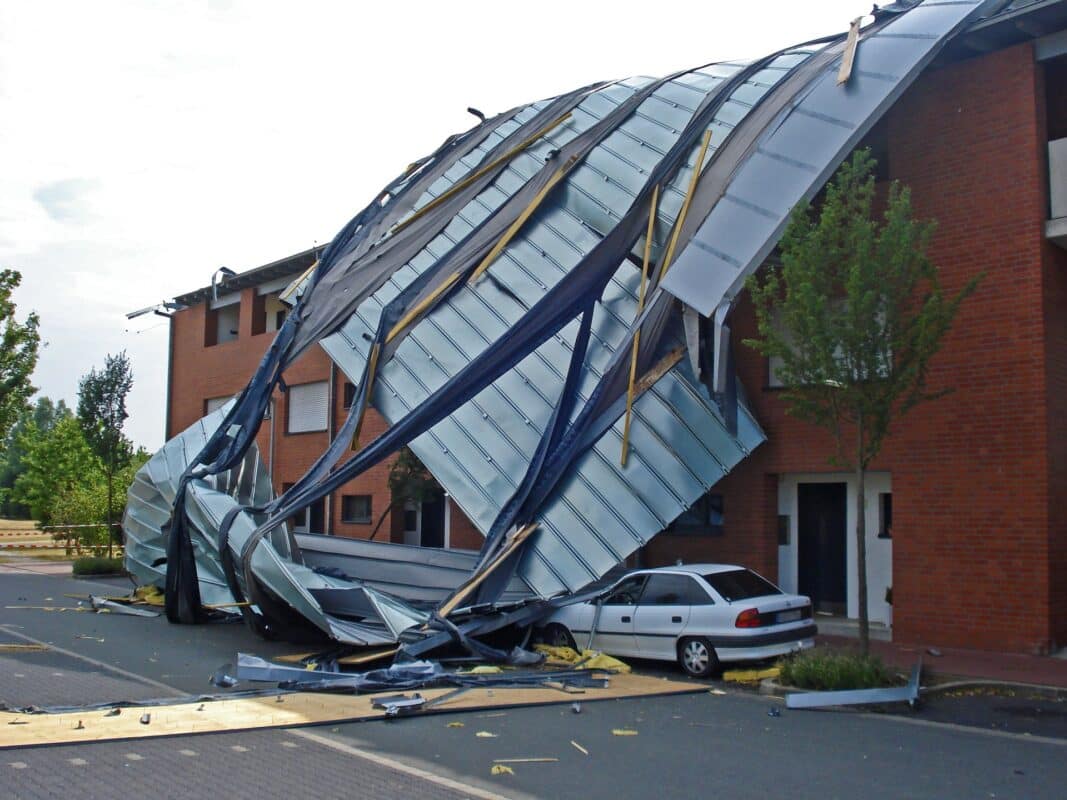
Membrane uplift at the leading corner is the most consistent tornado failure pattern we document in the St Louis market. Tornado wind rotation creates the highest uplift pressure at the upwind building corners, the zones where IBC wind tables already require the heaviest fastener density. On buildings with correctly specified corner-zone fastener patterns, we typically find the membrane held at the corner and failed at the adjacent field zone where fastener density steps down. On buildings with undersized corner-zone fastening, the failure initiates at the corner and propagates rapidly across the perimeter in both directions.
Debris perforation in the field membrane is the second consistent pattern. Even a moderate tornado produces airborne debris at velocities that punch through 60-mil TPO and 60-mil EPDM. We have found 2x4 lumber embedded in field membrane, gravel from adjacent roofs piled against equipment curbs, and HVAC duct sections from neighboring buildings draped across parapet caps after tornado events in the metro area. Each perforation is an active water entry point that requires immediate temporary sealing before the permanent repair scope is developed.
Response Coordination After a Major Tornado Outbreak
Major tornado outbreaks in the St Louis metro affect multiple buildings simultaneously across a damage corridor that can extend from south Jefferson County through North County in a single event. After the 2011 Good Friday outbreak and the 2024 sequences, we coordinated inspections and repairs across multiple commercial properties on simultaneous schedules, providing a single point of contact for property managers handling multiple buildings in the damage path.
For property management companies and REITs managing portfolios in the St Louis metro, we produce coordinated inspection reports across all affected buildings with consistent documentation format, allowing the portfolio manager to present the full damage picture to a single insurance carrier in a single submission package. That coordination reduces the administrative burden on the property management team and typically accelerates claim resolution compared to multiple independent contractor reports.