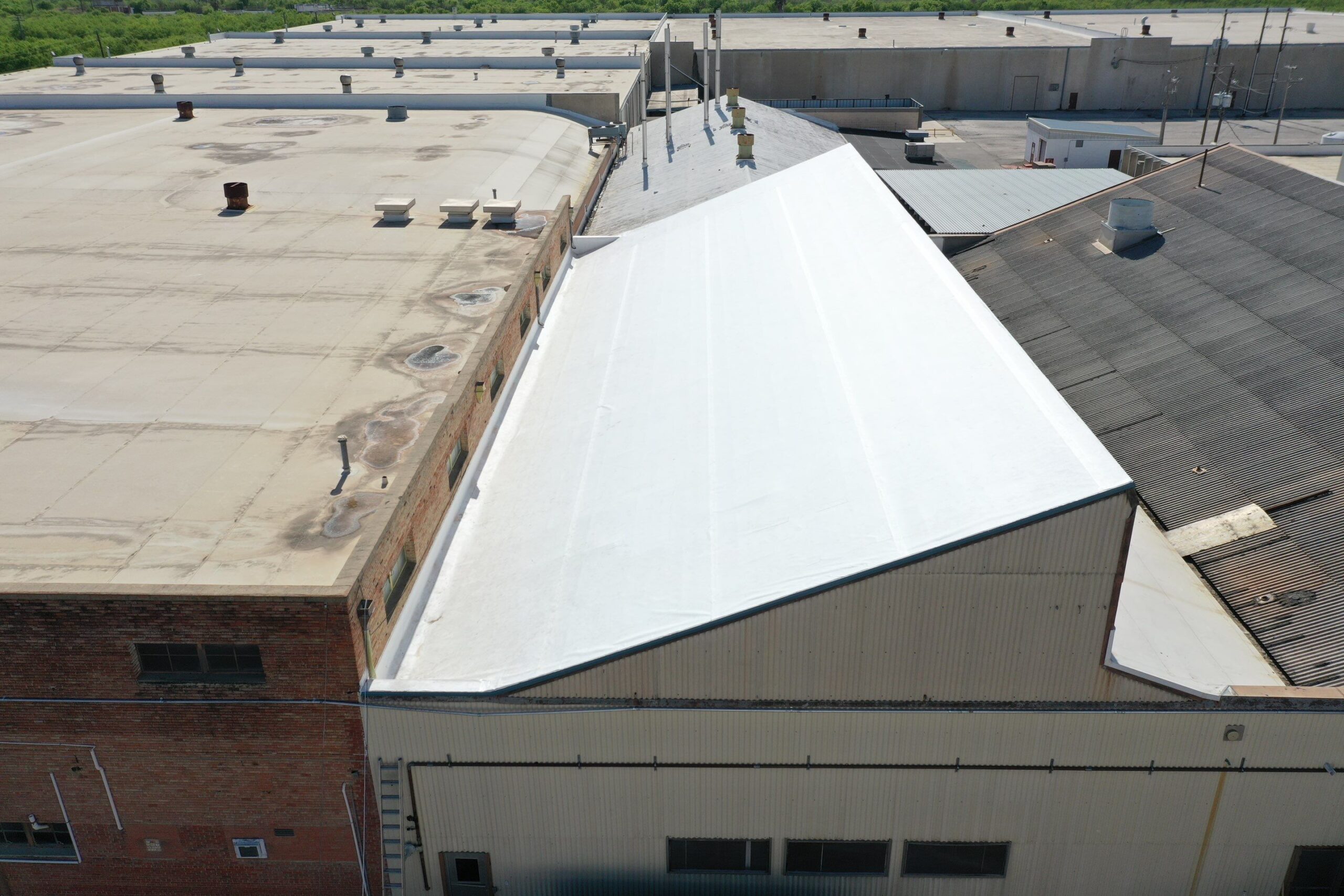
The Four-Part Decision Framework
Part 1, Moisture distribution: We pull cores at a minimum density of one per 2,000 to 2,500 square feet of roof area, with additional cores at all reported interior leak locations, at drain fields, at parapet-adjacent zones on north and west exposures where freeze-thaw concentration is highest, and at any area where a prior infrared scan identified probable saturation. Each core is assessed with a calibrated moisture meter, measured at every layer, and photographed. If more than 20 to 25 percent of the roof area is wet, the threshold that matches most manufacturer recover-warranty eligibility requirements, we recommend replacement. Below 20 percent, the recover path is moisture-viable. Between 20 and 25 percent, the spatial distribution matters: concentrated wet zones that can be surgically removed and replaced during recover preparation are a materially different situation than diffuse saturation dispersed across the field.
Part 2, Deck condition: Wet insulation that has remained saturated over multiple freeze-thaw seasons deteriorates the deck below it. On metal deck construction, the standard on St Louis commercial buildings from the 1970s forward, we pull inspection ports at wet core locations and at any visible deck deflection point. Corrosion at drain sumps and at parapet-adjacent fields where water channels is the specific failure mode we look for. On older St Louis commercial buildings in the Soulard corridor and south city industrial zone, some built on poured concrete decks or structural steel over wood, the deck condition assessment is different, and the implications for the recover recommendation are more complex.
Part 3, Warranty status: If the existing system carries an active manufacturer warranty, that warranty is a material input to the recover decision. Carlisle's recover-over-existing warranty program, under specific conditions, offers continuing coverage or warranty term credit when an eligible system is in good condition at recover time. We document the existing warranty number, remaining term, and the specific manufacturer's stated recover-warranty eligibility criteria before finalizing the recommendation.
St Louis-Specific Factors in the Analysis
Freeze-thaw concentration at north and west parapets: St Louis's winter wind patterns drive freeze-thaw cycling hardest into north and west parapet face assemblies. Buildings oriented with long parapet runs facing northwest, common on the east-west arterial commercial corridors in Clayton, Maplewood, and the St Louis City commercial strips, consistently show higher moisture concentration in the parapet-adjacent zones than in the field membrane zones. We core these areas at higher density than standard grid distribution when the building's orientation presents this risk.
Hail exposure and cover board damage: St Louis sees hail events averaging five to eight per year, with major events every two to three years. Buildings that have absorbed two or more significant hail events without comprehensive damage assessment may have cover board compression that a moisture meter does not detect. Compressed cover board under a recover membrane inherits the compression and creates localized ponding patterns that undermine the new system's drainage design. We cut inspection panels at hail-suspect areas before finalizing the recover recommendation.
Missouri energy code at recover: Missouri's IECC 2021 implementation requires R-25 minimum for low-slope commercial roofs. A recover that adds an inch of polyiso (approximately R-6) over an existing system already meeting R-19 may or may not achieve code compliance depending on the municipality's enforcement of energy code at recover versus replacement. We confirm the applicable code cycle and jurisdiction interpretation before presenting the capital comparison.
What the Written Report Contains
Core log: Core location on the zone diagram, layer-by-layer description (membrane, cover board, insulation type and thickness, any prior recover layers, deck type), moisture reading at each layer, and photograph of each core pull. The core log is the primary data source for the moisture distribution assessment and the document a manufacturer needs to evaluate recover-warranty eligibility.
Deck condition summary: Inspection port findings and photographs, with locations mapped on the zone diagram. Any deck conditions that affect the recover recommendation are explicitly called out rather than buried in narrative.
Warranty documentation: Existing warranty document or reconstructed warranty record (obtained from the manufacturer's warranty desk using the building location and approximate installation date), remaining warranty term, and the manufacturer's stated recover-warranty policy for the specific system.
Missouri Code Constraints on Commercial Roof Recovery in St. Louis
Missouri adopts the International Building Code, which limits commercial buildings to two total roofing membranes before full tear-off is required. Buildings in St. Louis metro municipalities, City of St. Louis, St. Louis County, and the major incorporated municipalities in the northwest and southwest corridors, have all adopted this limitation. Buildings that have received one prior recover over the original system are at the code limit regardless of the existing membrane's apparent condition.
We document the existing assembly ply count through core sampling on every St. Louis commercial building where recover is under consideration. The older commercial building stock in the City of St. Louis, in the historic Clayton business district, and along the original Manchester and Gravois corridors sometimes has received successive recover layers over decades without reaching a full tear-off decision. When the code limit has been reached, the correct scope is tear-off.
Moisture Core Protocol for St. Louis Recover Decisions
Moisture core assessment for St. Louis recover decisions requires a core pattern that covers the range of conditions present on the building: drain pan locations, parapet inside corners above known leak history, mid-field control locations, and any area with ceiling staining evidence. Missouri's humid summers produce conditions where moisture infiltration accumulates in insulation assemblies rather than drying out between events, which means the 25 percent threshold assessment requires a thorough sampling pattern rather than a minimal core pull.
We pull moisture cores and record results at every St. Louis recover assessment. The core locations are documented on the zone map and the results are presented in the assessment report as the evidence basis for the recover-versus-replace recommendation. For St. Louis commercial buildings where the recover decision is genuinely close, meaning moisture is near the 25 percent threshold across multiple core locations, we present both scenarios with full cost and risk documentation and let the building owner make the decision with complete information.
Derecho and Ice Storm Damage Considerations in St. Louis Recovery Scopes
Missouri's derecho frequency and ice storm exposure mean that recover scopes on St. Louis commercial buildings need to address storm damage history as well as normal aging degradation. A building that has received one or more significant storm impacts over its roof's service life may have localized insulation saturation or membrane damage that the exterior condition does not reveal. We document any known storm history for the building and include a targeted moisture assessment at the locations most likely to show storm-related damage: perimeter zones where wind-driven rain concentrates, drain areas that may have backed during storm ponding events, and penetration locations where impact or wind pressure may have compromised flashing integrity.
For St. Louis commercial buildings where a recover scope is being proposed after a recent significant storm event, the recover eligibility assessment needs to confirm that the storm event did not introduce moisture that exceeds the recover threshold. A post-storm moisture survey conducted 48 to 72 hours after the storm provides the moisture data needed to determine whether the building is still a recover candidate following the event.