Capabilities

Infrared Roof Scanning, St Louis Commercial Buildings

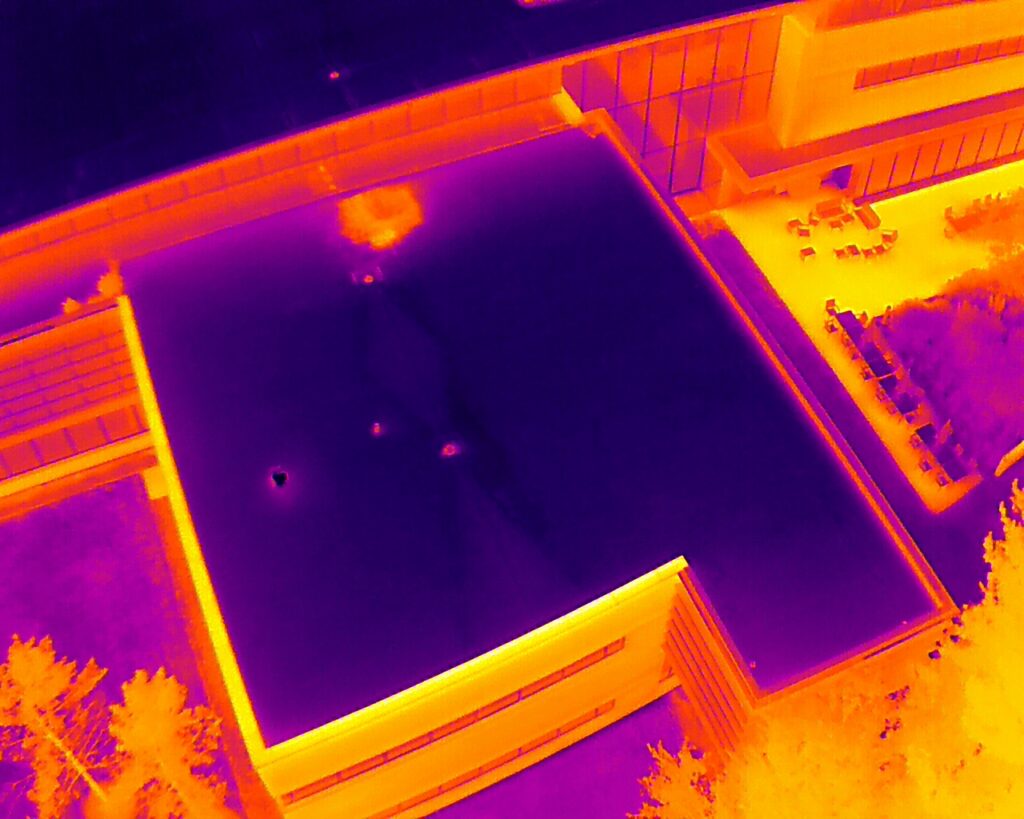
Infrared thermography detects moisture-laden insulation by its thermal signature after dark. We conduct post-sunset IR surveys on St Louis commercial roofs as part of moisture assessment and as a standalone condition-verification tool.

Capabilities

Infrared Roof Scanning, St Louis Commercial Buildings

Gateway Arch National Park sits at the Mississippi River's west bank in Downtown St Louis, where summer evenings deliver the temperature differential that makes infrared roof scanning reliable: warm river air holding heat late into the evening against a clear sky that allows rapid cooling of dry roof surfaces. That same thermal environment exists across the St Louis metro from May through October, making the region well-suited for post-sunset IR scanning on the commercial building stock.

Infrared roof scanning works on a thermal principle: wet insulation retains heat longer than dry insulation after the sun sets. During the day, the entire roof assembly heats under solar load. After sunset, the dry areas cool rapidly while the moisture-laden areas continue to radiate stored heat. A calibrated infrared camera captures that differential. Wet zones show as warm anomalies against the cooling dry field, and the result is a thermal map of suspected moisture infiltration across the entire roof surface in a single survey pass.

We conduct infrared surveys in the St Louis metro as a complement to nuclear gauge scanning and as a standalone large-area screening tool. IR scanning is non-destructive, covers the entire roof in a single pass, and produces results visible in the field during the survey walk. The thermal map is then confirmed with targeted core samples to verify the anomalies before the final report is written, which is what makes the IR data actionable rather than speculative.

Infrared Roof Scanning, St Louis Commercial Buildings

Scope clarity

What the written scope needs to settle

Infrared thermography detects moisture-laden insulation by its thermal signature after dark. We conduct post-sunset IR surveys on St Louis commercial roofs as part of moisture assessment and as a standalone condition-verification tool.

The written recommendation should separate immediate water-control work, system-level defects, drainage concerns, warranty limitations, access constraints, and capital timing so ownership can decide without guessing.

Survey Protocol and Equipment

Our IR surveys are conducted by certified thermographers using calibrated long-wave infrared cameras with thermal sensitivity of 0.05 degrees Celsius or better. The camera is calibrated before each survey for ambient conditions including air temperature, wind speed, and surface temperature. Surveys are conducted at a consistent walking pace with the camera held at a consistent height above the membrane surface, producing a systematic coverage pattern across the entire roof.

Each anomaly detected during the walk is flagged with a GPS waypoint and photographed with both the IR camera and a visible-light camera. The IR image shows the thermal pattern; the visible image shows the corresponding membrane location. Both images are referenced to the roof zone diagram in the final report. We do not conduct IR surveys in conditions that will produce unreliable results, including wind above 15 mph, recent rainfall on the membrane surface, or cloud cover that prevented adequate solar loading during the preceding day.

What IR Scanning Identifies and What It Does Not

IR scanning reliably identifies moisture-laden insulation that has stored more heat than the surrounding dry areas. It is highly effective on single-ply membrane systems over polyiso or EPS insulation, the most common configuration on post-1990 commercial buildings throughout the St Louis metro. Anomalies are confirmed with core samples before the report categorizes them as wet insulation. The combination of the thermal screen and the physical core confirmation is what produces a defensible recover-versus-replace recommendation.

IR scanning is not reliable on ballasted systems where the ballast layer masks the thermal differential, on roofs with thick concrete topping slabs, or on systems with multiple layers of membrane and insulation that produce complex thermal stratification. For those systems, nuclear gauge scanning is the preferred moisture detection method. We identify the right tool for each building's system type before mobilizing, and we are direct when IR scanning is not the right choice for a particular application.

Combined IR and Core-Sample Reports

An IR survey alone is a screening tool. It identifies locations for follow-up investigation, not a definitive saturation map. Our standard protocol combines the IR survey with targeted core samples at a representative sample of the anomaly locations: one core per anomaly cluster identified by the IR, plus one core in the driest area of the roof to establish the baseline. The combined report gives the building owner both the aerial view from the IR scan and the physical confirmation from the cores.

For St Louis buildings going through a pre-sale assessment or a capital planning review, the combined IR and core report is the most complete moisture documentation we can produce. It satisfies the documentation requirements of most lenders and institutional buyers active in the Clayton, Chesterfield, and Earth City commercial corridors, and it provides the data depth that an independent assessor needs to evaluate the roof capital requirement without relying solely on our interpretation.

Common False Positives in the St Louis Market

HVAC exhaust heat rising through the membrane, roof penetrations with equipment operating at above-ambient temperature, areas with black-body caulk or patches that absorb and retain heat differently than the surrounding membrane, and standing water on the surface all produce thermal anomalies that can be mistaken for wet insulation. We identify and document all apparent false positives in the anomaly log before reporting and verify with physical cores before categorizing any anomaly as wet insulation.

In the St Louis industrial corridors, rooftop HVAC equipment density on manufacturing and distribution buildings can be high enough that the equipment-related thermal signatures create a complex background against which moisture anomalies need to be carefully distinguished. Our thermographers are experienced with this condition and manage the survey routing to create the clearest possible comparison between equipment-influenced zones and field areas where wet insulation is the primary suspect.

Seasonal Scheduling for St Louis IR Surveys

The thermal window for effective IR scanning in the St Louis market runs from late April through mid-October. The earlier months of May and June offer the advantage of consistent temperature swing after sunset combined with the fact that spring storms may have recently opened flashing failures that are still admitting moisture, making saturation patterns easier to detect. Late summer scanning in August and September captures the accumulation from the full summer heat cycle.

Winter scanning is technically possible but significantly less reliable in St Louis because the low sun angle and reduced solar intensity during December through February do not load the roof assembly enough to create a reliable temperature differential after dark. We do not recommend winter IR surveys for recover-versus-replace decisions in the St Louis climate. For buildings that need a moisture assessment in winter, nuclear gauge scanning is the more reliable method during cold months.


Start with evidence from the roof, then decide the repair, coating, recover, or replacement path.

Roof Questions

What owners usually need clarified

What time of year is best for an IR survey in St Louis?

Late spring through early fall, May through October, when daily solar loading is sufficient to create the thermal differential the camera needs to detect wet insulation. Surveys in November through March are often inconclusive because the low sun angle and reduced solar intensity during the day do not load the roof assembly enough to create a reliable thermal differential after dark.

How large of a roof can you survey in one night?

An experienced thermographer can survey 60,000 to 80,000 square feet during a single post-sunset window, depending on roof complexity and the number of rooftop obstructions. Larger roofs are surveyed over multiple nights with consistent conditions. We provide a survey schedule before mobilization so the building owner knows the scope of each night's work.

Do we need to vacate the building for an IR survey?

No. IR surveys are conducted entirely on the roof surface and do not require interior access. Building occupants and operations are not affected. We coordinate with the facility manager to ensure roof access is available for the survey team and notify the building's overnight security of the survey schedule.

Can IR scanning detect moisture under any membrane type?

The thermal principle works under TPO, EPDM, PVC, modified bitumen, and built-up roofing. The scan detects the insulation's thermal behavior, not the membrane type. Highly reflective white membranes reduce the daytime heat load slightly, which is factored into the scan timing and camera settings. Ballasted systems and systems with multiple insulation layers are not reliable candidates for IR scanning.

Related Roof Decisions

Keep the conversation connected

These pages cover nearby roof questions owners often need to resolve before a final scope moves forward.

Capabilities

Commercial Roof Inspections in St Louis

A roof inspection is only useful if it produces a written record you can act on. Every inspection we run in the St Louis metro generates a condition report, a photo-keyed zone diagram, and a scope recommendation, not a.

Capabilities

Commercial Roof Moisture Surveys, St Louis

Visual inspection cannot find wet insulation. Moisture surveys using nuclear gauge scanning and targeted core sampling give St Louis building owners actual saturation data before any recover-versus-replace decision is.

Capabilities

Competitive Bid Coordination

We help St Louis asset owners write roofing scopes specific enough that multiple qualified contractors can price on equal footing, then we submit our own bid alongside everyone else.

Services

Commercial Roof Inspections in St Louis

A roof inspection from our team is a written condition report, not a verbal summary. We document what we find, membrane condition, flashing failures, drain status, penetration detail integrity, with photos keyed to a.

Roof Systems

TPO Roof Systems in St Louis

Thermoplastic polyolefin is the volume-grade flat-roof membrane for the St Louis commercial market. We install TPO on mechanically attached, fully adhered, and induction-welded configurations, each scoped to the.

Capabilities

Roof Condition Reporting, St Louis Commercial Buildings

Condition reports are the foundation of every capital decision we support. We produce written, photo-keyed reports that give St Louis building owners a zone-by-zone picture of the roof's current state, not a verbal.